Fiction in 2013: The Ugly Truth (and a call for patience)

iStock_000015635745XSmallOkay.

So I was going to write a post about the sorry state of fiction publishing during this transition period, as we watch the established presses, gatekeeper agents, chain booksellers and respectable book review outlets grind through the death throes of their former heyday — those days soon gone forever when they got to decide what books we should read.

I was going to detail a few of the horrors that one former “mid-list writer” (me) witnessed as she set off on her lonely road to self-publication, and witnesses still as she trudges down the even more harrowing and thorny trail of self-published-book promotion. Several of the appalling sights I’ve seen have contributed to a precipitous decline in my faith in my fellow human beings, such as:

  • New lows for the publishing industry. Traditional publishers have “evolved” from basing their guesses about what books they should publish next year on last year’s bestseller lists, to basing them on the lists of top-selling self-published novels — whose authors they then race to sign. How ironic is that?
  • Sticking fingers in the dam as the ship goes down. Almost all traditional book review outlets, booksellers, awards competitions and funding agencies continue to refuse to review, sell or reward self-published books on principle, no matter what the track record of the author or the quality of the self-published book (why? Because they might have to THINK if they were to become more open? How much easier it must be to simply proceed as they always have done, by accepting only those books published by traditional presses?). This makes book promotion for former mid-list writers very difficult, but it also means that readers who are wise enough not to participate in on-line review forums never hear about self-published books with any literary merit;
  • The Crap. Oh, the Crap. I draw your attention here to the hundreds of thousands of works of so-called fiction that have been released into the marketplace in the past few years by self-published writers who are incompetent, inexperienced, badly edited, and/or merely ignorant or boring, many of whom grow apoplectic and even threatening if anyone suggests that they don’t know how to punctuate, much less how to write (This enormous garbage heap is offered as justification by publishers, booksellers, review outlets, awards organizers and granting agencies for continuing to proceed as they do, and I do not argue that it is a major issue. However, a bit of diligence on the part of these institutions could sort the wheat from the chaff – sorting is not THAT difficult – but who has time to be diligent when your house is crumbling around you?) ;
  • False Positive Reviews. Then we have the proliferation of ridiculously positive, 5-star reviews of the aforementioned Crap now posted to Amazon.com, Goodreads, book-review blogs, and other book-related sites. Most of these patently fluffy reviews have been written by the authors’ well-meaning but inexperienced, uninformed and not widely read friends and relatives. One book-review blogger favourably compared an utterly talentless writer to one with the world-class stature of, let us say, a Jane Austen – a comparison that was then, of course, gleefully quoted by the writer in subsequent promotion. Now, if you were an unaware book buyer and a fan of Jane Austen, would you know to proceed with caution? I don’t think so. (Yep. It’s a zoo out there. Be careful where you step);
  • Books that sell on reputation and gossip rather than content. These are the Honey Boo-Boos of the current literary world. Take, for example, the Fifty Shades series, which has sold an astounding, gut-wrenching, nauseating 68 million copies so far. (Lest anyone accuse me of sour grapes, I have no qualms admitting that I am fifty shades of green over E.L. James’s book sales, but I would never, ever want to be associated with such bad writing, even in exchange for a lot of money. Thank you anyway, Mephistopheles.) As far as I can tell, this phenomenon MUST be due to the lack of literary reviews of the book, for why would anyone spend good money on a totally unerotic, misogynistic, implausible piece of shit? The only possible explanation is that  is that 67.32 million of those 68 million purchasers bought the book by mistake. I’m telling anyone who hasn’t yet made the error: I bought the first book in the series. I read as much as I could stand. I threw it in the garbage. Don’t waste your money. Read Anaïs Nin or someone else who can actually write erotic fiction instead);
  • Review Police: Then we have the packs of on-line sleuths, most of whom hide behind pseudonyms, who apparently have an intense dislike of writers in general and suspect us all of being guilty of the most nefarious crimes, particularly ones pertaining to reviews. (I have personally been the victim of their sordid and senseless attacks when I stupidly ventured onto their forums to point out the errors in their thinking. Like two-year olds, their arguments are not constrained in any way by the need to use logic, and they will therefore win all arguments). Among other things, such individuals believe to the very cores of their Neanderthalean little hearts that if you have received a free copy of a book rather than purchased it, you are incapable of writing an objective review of it. This opinion of course invalidates every review that has ever been published in the New York Times, the Globe and Mail , the London Review of Books, or any other respected review publication: since the beginning of (literate) time, reviewers have not paid for books they have reviewed; they have received the free review copies that have been sent to the publications by the publishers. The “review police” seem to have very little to do with their lives aside from hunting down authors they can report to the Amazon gods for having engineered positive reviews for their own books – or, better yet, of having written such reviews themselves, using false names. Such witch hunts commonly occur on the Amazon Top Reviewers Forum (which is not exclusively about books, but also talks about reviews of toilet plungers and whatnot; here is, however, a charming recent thread that reveals the biases of many of the habitues of the forum) and The Kindle Forum;
  • Overkill Response by Amazon: Last fall, Amazon responded to accusations by these sleuths by deleting thousands of reviews by writers, inflammatory or not. Here are the details, as set out in the New York Times and The Telegraph;
  • Last but not least, it doesn’t help that at least one traditionally published author has admitted to actually doing what we are all being accused of doing: not only has R.J. Ellory written reviews of his own books and posted them under pseudonyms, he has also used fake personae to slag his fellow authors.

So, yeah. It’s a pretty disgusting time to be a fiction fan – as I am, both as a writer and a reader. I remember a bookseller once telling me (about 30 years ago) that she didn’t bother to take ID from book purchasers when they wrote cheques because they were all so honest. The nature of the beast seems to have changed, and I am very sorry to be seeing it.

What I was going to do was to just advise everyone to stay away from fiction–even mine!–until this all shakes down. If you can’t trust what is being published to be good, and you can’t trust the reviews to be honest, much less representative, then what’s the point?

But then I reminded myself that this IS just a transition stage. I reminded myself how far we’ve come in the past four years. I remembered how I’ve noticed that several of the newly published writers I didn’t feel were very good seem to have given up on their dreams to become millionaires from writing the next knock-off Twilight, and stopped plugging their books everywhere. It seems likely that many others who are not “real writers” will follow because this is (as it always has been) a hell of a lot of thankless work.

I thought about Malcolm Gladwell’s 10,000 hours and reminded myself that I’ve been at this fiction-writing stuff – working at improving my writing – for more than thirty years now. I reminded myself that I finished my (first) half marathon back in the 1990s , and lost 30 lbs last autumn, by keeping on and keeping on–no matter what. Giving up on writing, even for a few months or years, is not an option anyway: I love to write. A writer is who I am.

I told myself that within another few years, there will be a new and much better system, in which the readers will find the good books for themselves from among all the self- and traditionally published books that are released, and then will tell the rest of us about them on book blogs that we will come to trust to point us in the best direction for our own personal reading interests. Within a few years, really good editors will offer to put their imprints on self-published books they’ve edited and liked. There will be awards programs that are open to both kinds of fiction publications. Writers who have established presses and agents will stop dumping and ignoring on principle those of us who are not dragging around similar litters of dependents. (See, for example, this.) We will have book review outlets we can trust to cover ALL good fiction writing, no matter where it comes from, and booksellers who will recognize their new roles as community gathering places for book lovers rather than as gatekeepers.

It will take a few more years for the evolution to shake down properly, but it will happen. And I am optimistic, despite my dismay and discouragement right now, that the world is going to be a better, more open and less expensive place for writers and for readers. And that we will once again be seen as a group as honourable people who are kind and supportive of one another.

So I decided not to write that depressing, bleak, discouraging blog post I had been thinking about after all.

Book Promotion Tip of the Week #5: January 4, 2013

Gold starCause a Ruckus

Do something that will attract attention and preferably cause a few (of the more intelligent and discerning) people (i.e., your ideal readers) to cheer you,  but will cause even more people to get so aggravated with you that they start write-in campaigns from bases in bunkers on writing forums and other blogsites that point out in blindingly mundane, uninformed and narrow-minded detail that you are ignorant, misguided and rude, and that if you think you are so hot and know so much, you should just prove it.

I have done this once before, on April 17, 2009, when I (rightly) denounced most literary agents and publishing companies in my first-ever blog post for The Militant Writer: about 4866 people stopped by in a single day and nearly 400 wrote comments – many of them in an effort to explain to me what an idiot I am (however,  those commenters in fact proved only that they don’t know the meaning of the word “irony,”  that they were utterly unaware of what was happening to the publishing industry at the time, and that they would do anything to suck up to agents such as Nathan Bransford, Janet Reid and others, in the faint hope that those august people might deign to even look at their work). That post (and its comments: I didn’t censor or repress any of them) has been read at least in part by 18,000 visitors to the site since I published it.

Unfortunately, I had no books online to sell that day. But I do now.  And now I have another article planned that should have a similar effect. I intend to put it up, right here, one week from today, if not before.

So wait for it… Wait for it…. Wait for it….

Book Promotion Tip of the Week #1: December 2, 2012

Gold starDemonstrate Your Excellence

If you are the author of a well written, well edited, self-published book, you need to help it get the attention it deserves. There are lots of people who will assume that just because your book is self-published, it must be crap – poorly written drivel featuring lots of typos laid out incompetently on the page.

Since there are, in fact, many “indie” published books fitting that description to a T, it is very difficult for most self-published authors to get their books reviewed by established media. To take advantage of this situation, some book-trade publications (including the erstwhile respectable Kirkus Reviews and Publishers’ Weekly) are now selling reviews for what I consider to be way too much money  ($425?? Are you kidding me? What’s the point? How is even a good review from one of these outlets–and the price doesn’t include any guarantees that the review will be positive–going to improve your sales? You’re still not going to be eligible for most awards competitions, and most established booksellers still aren’t going to stock your books. Furthermore, your average readers couldn’t give a damn about Kirkus Reviews or Publishers’ Weekly–if they even know what they are). As far as I’m concerned you can spend your book-promotion budget, if you have one, much more wisely.

To help get your wheat to stand out from the chaff:

1) Submit your book to every awards program for published books for which it is eligible that you can afford. (Some awards programs are also quite expensive, and may not be worth the investment, especially if there are likely to be so many books submitted that winning becomes a crapshoot: check out the previous years’ winners of these competitions. But don’t dismiss award competitions just because they cost a bit of money: there are certainly administrative costs involved–including, we hope, some payment for the judges.) Don’t overlook local and regional competitions, and those specific to your genre (e.g. western, historical fiction, speculative fiction). Google to find them (“writing competitions self-published books, steam punk” for example). You may not win, but you may be a finalist or semi-finalist, as The Whole Clove Diet was in the Amazon Breakthrough Novel Competition four years ago, or you may not be even a semi-finalist but may still get a great review from a judge that you can then use in promotion (as I recently did from the Writer’s Digest Self-Published Book Awards);

2) Look for groups of readers that are giving their stamps of approval to well written, self-published/indie books, and submit a copy of your book for their review. Leaders in this field include the folks at the Book Readers Appreciation Group (B.R.A.G.): their readers evaluate books that are nominated or submitted, and the ones they find to be of sufficient quality receive a B.R.A.G. Medallion and appear as recommendations on their site. Such notice can bring side-benefits aside from the actual selection: not only was The Whole Clove Diet a B.R.A.G. Medallion honoree (which is an accolade I can and do use in my promotion and on my website), the news of its status was also tweeted by the B.R.A.G. organizers and mentioned on their Facebook page. Recently the novel was also named a B.R.A.G. Book of the Week, which gave it even more attention.

Aside from B.R.A.G., there are many other sites that are devoted to helping readers sort the worthwhile from the junk in indie/self published books. (I invite you to add your recommendations of such sites as comments to this post for the benefit of other writers.) In a world where agents and publishing houses are no longer the gatekeepers they once were, readers need to help other readers find the best new writers and books around. When they get themselves organized into groups (or become individual book review bloggers), the work they do benefits us not as readers, but as writers too.

It’s A Wrap! Create a really effective cover for your book – Part II

In Part II of this mini-series of blog posts about book covers, I talk to my friend and colleague J. Allen (Jeff) Fielder about how writers can ensure that their covers attract readers to their books. Jeff is a graphic designer who has created covers for several independently published authors in the past few years, along with a number of other related products such as bookmarks and web graphics. He is employed full time as a graphic artist, and is also a writer of fiction and nonfiction and a photographer. His own second book – and first book of fiction – a collection of short stories entitled Voices of the Field, is currently in production. Check out some samples of his covers and info about him on his website: JAllenFielder.com

MWW: So, is it true that “You can’t judge a book by its cover?”

JAF: It’s completely untrue. You can judge a book by its cover—and people do it all the time, probably even more so in the digital age. Today, what your book looks like on a screen at about 1 inch by 1.5 inches can be the tipping point between whether someone clicks on it to read more, or just keeps scrolling.

MWW: Aside from being interesting to look at, what else does a good cover do?

JAF: Every genre has its own expectations about what a good cover looks like. Black and minimal is the style, for example, in young-adult urban fantasy, colorful and cartoony for feel-good adult fiction. A designer can help guide you through what your cover should look like, based on its tone, content and target audience. But there has to be more to it than just looking good: the cover has to look good up close as well. The covers of many self-published books I’ve seen have no depth to them. They are flat text on flat photos. That sends a message to the reader: if the cover is flat without depth, the book probably is, too. The designer has the experience that helps you to overcome issues like that which you might not even be aware of.

MWW: Okay, so clearly we can’t afford to go with something we whipped up in PowerPoint. But authors are often afraid that they can’t afford a cover designer. How much do you people charge, anyway?

JAF: Be ready to spend $200 to $500 on a good cover. You can probably get by with cheaper, but just like buying at a dollar store, you’re probably going to get what you paid for. You can find hungry designers in high school and college, but will they know how to work with vendors? Will they know how to set up bleeds, and trims, and the format types each vendor requires? Will your designer spend more time trying to figure out how to set the file up than actually designing?

MWW: Tell me about the process that a designer goes through when creating the cover of a book.

JAF: In my case, first I have to understand the book, either by reading the manuscript, or getting a detailed brief. Then I need time alone, maybe even a few weeks, to go over ideas, before I involve the author. I might spend days upon days going through stock-photo sites, or thinking about how I can shoot a photograph myself – evaluating whether a photo is even the right approach. After that, there’s constant dialogue with the author. I ask them questions about their tastes: “Do you like minimalist art? A particular text? What other book covers do you like?” Together we explore color palettes, and font treatments, and theme. In short, there’s a lot more than just going to a photography website, typing a key word or two, finding an image that appeals to you, and slapping Comic Sans on it.

MWW: You can’t just go to a website, find a photo and use it on your book anyway, can you?

JAF: No, you can’t. And it’s really not as simple as going to a stock photo Web site and buying a $10 photo, either. First, of course, there’s copyright. Even if it doesn’t expressly say it’s copyrighted, assume all photographs and images are. Just because it’s on the Internet, doesn’t mean it’s free. Also, photographs, paintings, even fonts, have what’s known as an End User License Agreement and Terms of Use. You have to read the fine print to know what it is you’re buying. Some stock photo sites will sell you a photograph, but the license only allows you to use the image on Web sites, or for personal use. Some stock photo sites require that for covers, or other resale, you have to buy an “Extended License,” which can cost up to several hundred dollars. So be careful, and know what it is you’re buying.

MWW: Sometimes you can’t get the image you want at all – as I recounted in Part I of this cover series, I ran into that with my efforts to get a Botero on my cover.

JAF: Or it might just not be worth it. One writer I was working with found a shot he really liked for his cover from a professional photographer. I contacted the photographer, hoping to work out a deal to license the image for the book. She wanted $500 to use the photograph, and $2,000 to buy the full rights. The $500 would have included the first 1,000 copies, and then the contract would have a continued life where every 100 copies after that would include royalties ($200). There’s no way the writer could ever have recouped that cost: it was probably more than the royalties he would make on his own book.

MWW: What advice do you give writers on how to work with a designer to get the best cover possible?

JAF: A good relationship with your designer should be one where there’s back-and-forth and understanding. A designer shouldn’t dictate, but neither should the writer. As a writer, you need to be able to bring ideas to the table, know what you want, and be able to express yourself. But you also need to have an open mind and be flexible. If either side lays down the law and won’t budge, you’re probably going to get poor results. Ultimately, you might get what you want and find out it’s not what your readers wanted. Your cover shouldn’t be about ego: your cover should help sell your book.

MWW: Obviously, choosing the right designer is almost as important as choosing the right cover.

JAF: You have to be able to trust your designer to take care of you. A good designer is not only going to give you the cover you want, but will know how to make it usable for all of your needs. Today, you may just want a great cover design so that you can sell the electronic version of your book, but when the time comes that you want to produce a paperback, a single front cover that can’t continue the theme to the spine or back flap isn’t going to do you any good. You need to be sure that your designer will set up the file so it can print large scale as well as small. Electronic images might look good at one inch by one inch, but if you go big and your cover wasn’t designed for it, you might have to start all over.

MWW: Thanks, Jeff. The ball’s in your court with the cover of my next novel, The Whole Clove Diet. I am looking forward to seeing what you (we) come up with!

* * * * *

Note to writers/independent publishers from Mary the Editor aka The Book Charmer: The text that goes on the back cover of your paperback version of your book is also critical. Go to a bookstore and pick up lots of books and really look at the elements on the back cover. What do you want? An author bio? An author photo? Quotes from pre-publication reviewers/readers of your manuscript? Reviews of one of your previous books? A brief summary of plot that gets the reader hooked?

Don’t try to include all of these components on your back cover – you don’t want the text too dense. And make sure you get your cover proofread: one of the first books I supervised through production as editor in chief at Lone Pine came out with the name of a government minister (who later went on to become prime minister!) spelled wrong on the back cover. And in those days, you were stuck with selling an entire print run before you could fix the error. Ever since then I triple check the text on the cover, and get someone else to take a look as well.

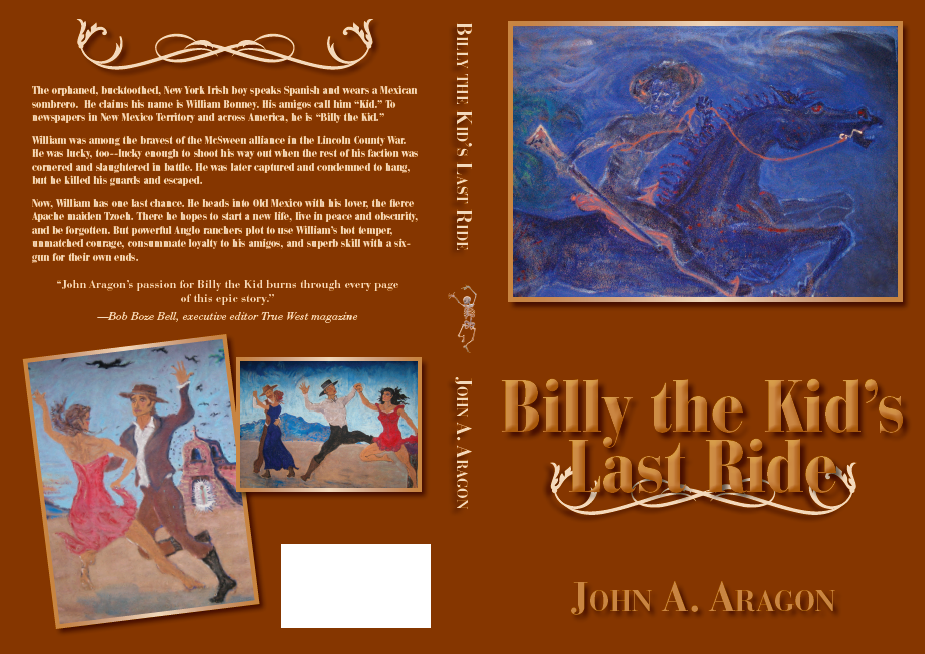
Once you have the text prepared, your cover designer will be able to help you compose a back cover layout that complements the design of the front cover and the spine. For a great example of this, check out the layout (and the design!) Jeff created for John A. Aragon’s first novel: Billy The Kid’s Last Ride
(Sunstone Press). The images on the cover are from John’s “Last Ride” mural in Santa Fe.

It’s A Wrap! Create a really effective cover for your book – Part I

Whether your book is published by an established press or you are doing it yourself, it is important to remember that what the outside of your book looks like is the first introduction many of your readers are going to have to the content, tone and quality of your book. Like it or not, your cover will provide the foundation for all of your marketing efforts. You have spent so much time writing the text; you do not want to reduce its impact by wrapping it in a less-than-impressive cover.

If you are publishing with a traditional press, your contract may not allow you any say in the selection of the cover of your book, although many writers are now requesting that their contracts give them at least some rights in this area (if publishers are expecting writers to do most of the promotion on their own books, they should at least give them a great-looking product that they are excited to hold in their hands and celebrate on their websites, right?).

I recommend that even if you have no legal ground to stand on, if you really dislike a cover that has been designed for your book, you say so. I never liked the cover of my second novel, Bitters, and told the staff at the publishing house how I felt, but they managed to convince me I was wrong. They suggested that I was a writer and not familiar with design elements. I wasn’t wrong – the colours are putrid and the design uninteresting – and I’ve regretted not being more assertive about it ever since.

****

In the second part of this two-part post, I’m going to interview the acclaimed book-cover designer Jeff Fielder – who created the cover of the newest edition of The Woman Upstairs (it was originally published by NeWest Press and I didn’t own rights to the original cover), and is also doing the cover for my next novel, The Whole Clove Diet. He has also created great covers for a number of other writers’ books, not to mention other promo materials such as bookmarks. You can see samples on his website here. Jeff will tell us how to find and work with a book-cover designer.

Before I report on that interview, however, I want to tell you a bit about what I learned about creating book covers when I worked as editor-in-chief at Lone Pine Publishing, and what I have attempted so far in the creation of a cover for my latest novel.

When I went to work at Lone Pine Publishing, my employer and the design and sales staff taught me an important thing or two about book covers:

  1. You want the cover to accurately portray not only the content, but also the tenor and even the complexity of the book itself. As far as content, think about conveying the era, the culture, the milieu the book is set in – not necessarily by portraying these things exactly, but by communicating the sense of them. For example, if your novel is set in early 20th-century Paris, you may not need a street scene that is an exact portrayal of the streets your narrator walks along; a drawing, even abstract, that evokes the same feeling as a rainy lamplit Paris street can have the same, or even greater, impact. If you’ve written a comedy, a somber cover will not suit, and a historical saga should not look like a steampunk novel. As far as stylistic complexity, if your writing emulates that of Feodor Dostoevsky or Ayn Rand, you may not want a cover image of a couple clutched in a passionate embrace à la Harlequin Romance, no matter how passionate your characters may be. Go to a bookstore: either a real one or online, or check out collections of book cover designs like this one. Look at books in the genre and style in which you are writing. Look at their covers for inspiration and guidance and to increase your own awareness: pre-teen novels do not look like detective novels for adults; books on creating effective websites do not look like biographies; westerns do not look like zombie novels.
  2. Design styles change. This can work to your advantage. If your novel is set in the 1950s, check out the original covers of novels published in that time period: emulating them can reinforce the time-frame of your book. The fact that design styles change is also something you should think about if you want your cover to remain effective for the next twenty years: you may not want to get too trendy;
  3. You will need to make choices about the content of the cover design. Are you going to use a photograph on your cover, like this one on a bio by my friend Peter Jonker does? A painting? A drawing? Perhaps a simple colour design with text? Each of these options presents a different message to the viewer and conveys something about the content of the book;
  4. Consider costs. Can you afford to commission an actual work of art for the cover of your book? Can you even afford permission costs to use a work of art already in existence? If you want a photograph, how will you access the one you want? You CANNOT use a photo or piece of art you find on the Internet without seeking permission from the creator and/or his/her estate: it is not only unethical, it is illegal. On the other hand, if you use a free or very cheap stock photo from a do-it-yourself cover-maker page, you may run into your cover illustration on the cover of someone else’s book or other product. But if you create your own photograph or work of art – or use a drawing by your clever seven-year-old – is it going to look sufficiently professional, or merely quaint and home-made?
  5. Did you know that the font you choose for your title, author name, and back cover text, is also communicating a message about the content of your book? Did you know that fonts also go in and out of style: there are quite a few people who actually “hate” comic sans because they’ve seen it in too many PowerPoint presentations, for example, and may be turned away from reading your book just because you used that font on your cover? You many want to investigate any non-classic fonts carefully before using them – unless, of course, the funky font you’ve chosen reinforces the tone of your book;
  6. Visual contrast is crucial to a cover. You want to make sure that people can read the text on the cover of your book. White text on pale gold may look great up close, but it’s almost impossible to see when the cover gets small enough to put on a website, or even on a shelf a few yards away across a bookstore. A very busy cover may also make your title invisible to the reader;
  7. What is your cover going to do to help your sales? Is it going to attract attention when it is reproduced for review on someone’s blog at about 3 cm x 3 cm? If a bookseller puts it in a book stand, is the title still going to show? Will it reproduce well on a poster, a brochure, a postcard, a bookmark or other materials you may choose to create to produce to promote your book?
  8. Remember that a cover is a wrapper for a book. It has three sections: the front, the spine and the back. If you choose different backgrounds for those three elements, what is going to happen to the appearance if the cover is cut a little “off angle” during the production process? Is the artwork for the spine going to actually appear on the spine, or is it going to angle across the spine? It is generally best to use the same predominant colour all the way around the cover so you don’t end up with off-kilter colour where you don’t want it.

These and many other questions should occur to you as you are creating your book cover, which you can do on your own for free with programs offered by self-publishing companies like CreateSpace, or online by Googling such terms as “book cover templates.” I recently read a great suggestion that you can make a jpeg for a book cover using PowerPoint.

You can also hire a cover designer who knows what he or she is doing (which is my preference, and as important to me as hiring an outside editor) or do it yourself. But whatever course you take, make sure you love your book cover and that it is “you,” as much as your writing is.

Fernando Botero, and The Whole Clove DIET Cover

Early in the period during which I was writing The Whole Clove Diet, I saw a painting at the Johnson Museum of Art at Cornell University that opened a whole new world to me. It was by Fernando Botero, a Bolivian artist I’d never heard of at that point, and I immediately identified it with the mood I was working to convey in the novel. The subject of the drawing was a young girl – round, as most of Botero’s subjects are—and she was smoking a cigarette. She looked feisty and assertive, defiant in spite of or perhaps in part because of her shape and her age-inappropriate nicotine-delivering accessory.

As I explored further I learned that the men and women in most of Botero’s paintings and sculptures may be far over a healthy BMI but they seem not to be concerned in the least about that. If they are not flaunting their pudginess, they are at least confident in their bodies and apparently certain of who they are.

Over the years since I have sought out and found many Botero paintings and sculptures to admire both online and in real galleries. I always imagined that when I was ready to publish (I assumed at that point that the world’s major publishers would be begging at my door for The Whole Clove Diet), I would ask my publisher to approach Señor Botero and secure permission to use one of his images for the cover. I had, in fact, chosen several paintings that I would particularly have liked to use.

When I decided to pursue publication on my own, I thought at first that I would need to abandon the idea of using a Botero on my book because I did not have the heft of a publishing company behind me. But then I decided that I should leave no stone unturned, so I began a rather lengthy process of figuring out how to contact the artist. With the help of a friend, I finally figured out who Botero’s representatives were in the United States, and contacted them. They said I could make a proposal to the artist through them, and so I proceeded to carefully prepare a letter to send to them, to send to him. I gave evidence to the artist (I hoped) that I was no first-time writer, that I respected and admired his work tremendously, and that although I could not afford to pay him what it might be worth for this one-time use (which I presume would be in the thousands of dollars), I would be happy to share any amount of the cover price of the book that he might be interested in suggesting. (I would not, of course, have agreed if he’d wanted too much of the cover price!) The owner of the gallery who represented Botero was very helpful, asking for additional information I had not included and even going to all the trouble to buy and read The Woman Upstairs, my first novel.

The pitch was not ultimately successful – Fernando Botero declined to allow me permission to use his art – but I gained from the experience anyway. I acquired a fan in La Jolla California (the gallery owner, who said she liked my book and is looking forward to The Whole Clove Diet. Thank you, Mary Beth Tasende!). And even though I was disappointed that Señor Botero said “No,” I would have been even more disappointed in myself if I had not tried to reach him. I would have wondered forever if he might have said “Yes” if I had just asked. I did the best that I could do, and even though the response was not what I might have wished, at least I have it.

A couple of my friends worried that if I did get permission, some prospective readers might not like Botero’s art, and might therefore not want to buy the book. Who knows? I still love his stuff, and I think that people who love good writing are also those who love good art.

However, the message I am trying to deliver here is that as writers pursuing the new world of “independent publishing,” we need to have some chutzpah. It is no longer enough for us to just write our books. Now we need to clothe them before we send them out in public. We need invest some energy, and maybe even some money, in making our books look as good as we have made them sound.

If you have a book cover you particularly like, tell us about it in the comment and add a link. Show us what you like about it. If it’s your book, tell us why you chose it.

How much more do you really earn when you self-publish?

(Third in a series of articles about the new realities for writers and readers. In this post, I attempt to compare the relative costs and potential profits of self-publishing versus traditional publishing, and explain which method of self-publication I have chosen for my next novel, The Whole Clove Diet – and why I have chosen it.) (Of course, none of us is really interested in making money from our writing, right? We are only interested in making art. ♬ )

It seems as though every time I go onto the Internet these days, I stumble over another post in which some author is enthusing over how much more he or she is making per copy on a self-published book (70% of the cover price or more) than he or she would have made with an established press (where a 10 to 15% royalty is the norm). Somewhere on The Militant Writer, I may even have crowed about this advantage of self-publishing myself. :)

While such statements may be accurate in absolute terms, they fail to take into account many of the costs outside of printing that are incurred by traditional publishers on behalf of authors’ books. Some established presses invest more than others (and some seem to invest next to nothing) in such make-or-break areas of book production as editing, cover and layout design, and promotion and marketing, but whether they are effective or not at what they do, publishers incur overhead costs with each title.

Many of these same costs are also incurred by self-published authors—or should be—but the authors may overlook them when they are calculating their final “take” from sales.

Self-published authors who fail to make their books look and read like something besides draft manuscripts that have been laid out at home and then slapped with amateur-looking covers are (in my opinion) fools. However, as soon as we start putting money into improving the quality and impact of our self-published books, the longer it takes for us to recoup the money we’ve invested. We cannot claim we are “making 70% of the cover price” of our books until we have paid ourselves back for our expenditures to produce them.

The biggest financial difference between having a book published by a traditional press and doing it ourselves is who pays the overhead, what the overhead entails, and how the proceeds are shared. In this post, I am going to take a stab at evaluating the relative costs of self-publishing versus traditional publishing, but keep in mind that attempting to compare the two approaches can be like weighing “apples” against “all citrus fruits,” due to the variety of publishing models that have begun to proliferate.

I encourage readers of this post who have self-published (aka “indie-published”) their books, participated in shared-expense publishing initiatives, or have info about traditional publishing that I may have overlooked here, to contribute to the comments section of this discussion.

No Money Down: Working With Traditional Publishers

When a traditional publisher offers to publish your book, you do not need to contribute any money. By inviting you to give them the publishing rights to your book, publishers are essentially saying that they believe that they are going to sell enough copies of your book to make up for the costs they will incur up front in order to get it to the marketplace – and then, they hope, make a profit by selling even more.

The costs traditional publishers incur are outlined in my “Authors and Publishers” post and they include:

  • copyediting and substantive editing
  • book interior design
  • cover design
  • layout
  • printing
  • promotion
  • sales
  • distribution
  • storage
  • overhead costs – these range from the rent, utilities, etc. that are part of the costs of maintaining an office and a staff (including executive editors who will read your manuscript in the first place—or pay someone to send you a form rejection letter—salespeople who go out to bookstores to talk up your book, promotions staff, art department staff, bookkeepers, shipping and receiving staff), operating a warehouse, paying the fees of freelancers, selling other (foreign, movie) rights to your book, legal, financial and accounting costs, costs associated with creating a catalogue, posters and other promotional materials, securing ISBNs and Books in Print notifications, etc., etc., etc.

If a press publishes 20 books a year and its annual expenses are $1 million, one could argue that each book costs the company around $50,000. Of course this is a vast oversimplification because books that were published in previous years that sell this year bring in income that helps to sustain the business, operating grants may be involved, or subsidies from institutions such as universities, funding may have been secured to help with marketing and promotion, and there are many other factors that need to be considered. So let us say that the cost of producing 5,000 copies of your book is $20,000.

Let us also say that the book thus created is going to sell for $20.

In that case, on each book:

  • You, the author, will receive about $3 (depending on royalty rates that are set out in your contract);
  • The booksellers will keep about 40% of the amount they receive for the books they sell, or $8;
  • The publisher will retain the remaining $9.

As you have already figured out, these numbers show that in order to pay itself back for the costs it has incurred, the publisher needs to sell nearly 2,500 copies of your book— half of the stock it printed – just to break even. Even after that, additional promotion, storage of unsold books, and other costs are going to need to be deducted from the publishers’ portion of the income from each book.

In this scenario, the author starts to make his or her paltry $3/copy from the first copy that is sold – although the author’s actual receipt of those $3 pieces is subject to such factors as:

  • Advances: The amount that has been advanced to you by the publisher must be reached before you will receive any more money. If the publisher advanced you $3,000 in our example, for example, since you are making $3/book you will not start earning any more money from royalties until after 1,000 copies of your book have sold;
  • Agents: If you have an agent, he or she will receive a cut of your take: let us say 15% of $3 =  45 cents, leaving you with $2.55. (This is why agents are only interested in working with writers who have the potential to sell a lot of books.);
  • Returns: The traditional book business is unlike almost any other business in that bookstores can return the products (books) they do not sell to the manufacturers (publishers). Your book is not sold when it is stocked by a bookseller, but only when it is purchased from the bookseller.

Costs to Self-Publish

The costs of self-publishing, by contrast, are entirely dependent on who the writer deals with, and what costs beyond book production (e-book and/or print version) he or she chooses to incur.

The Rip-Off Artists

Let us dispense first with the companies that advertise on-line that even though they accept every book that is submitted to them, they are still traditional publishers because they will give you an advance and publish your book at no cost to you. Closer examination of these companies (and reviews from those who’ve used them) indicate that the advances are minimal ($50 or so), the printed copies are expensive (e.g., $20 to $25 or more), the “publishers” often do not make any real effort to get the books into major sales outlets (including onto Amazon), there is no e-book option, and the major thrust of such companies is to hard-sell copies to the authors. (In one contract I read on-line, the company assures authors that review copies will be distributed, but only to reviewers who write to the company asking for a copy of your book. How many independent, respected reviewers do you think you can convince to write to your publisher and ask them for a book? It isn’t going to happen.)

Similar methods were used by what is known as “vanity” presses in the past: they offered you “free publishing” as long as you agreed to buy 1,000 copies of the finished book, which of course you would then need to sell yourself. People invested huge amounts of money in such scams and ended up with hundreds and hundreds of copies of unsellable books in their basements. In this era of print-on-demand, you don’t need to buy all those copies up front, but the principle is the same: the only entity that makes any money off such ventures is the “publishing” company.

Some other companies have recently been created that are in the e-books-only business. They also offer publication at no cost to you, but they spend almost nothing anyway: all they really do is pour your text into a file, slap a cover image on it, and then put the book up on the Internet. No real editing, no significant effort to market your book, no real investment on their part. They then stand back and simply take a cut of whatever sales you are able to drum up.

Check the fine print in the contract with any self-publishing enterprise as closely as you would (or should) with any other venture in which you have chosen to participate. If it sounds too good to be true, it probably is. Ask to see what the publisher is prepared to do to help promote your book (and then make sure they do it), seriously consider the books it is already offering and determine whether you want to be associated with those books and authors, and Google to find if there are any negative comments about them from authors who have used them in the past. Keep in mind that the testimonials that appear on the “publisher” websites are those that have been pre-approved, and even their on-line forums may be censored to weed out negative feedback.

In other words, caveat emptor.

Bare Bones Self-Publishing

The lowest cost I have found to self-publish a book with a reputable company is $299. With this very basic option, the author provides all text pages and the cover in “camera-ready” PDF format so that the publishing outlet doesn’t need to do anything but assemble the book on a computer so that it is ready to be printed, one copy at a time (known as “print on demand,” or POD), whenever anyone orders it. An example of this basic service is the CreateSpace Author’s Express, and CreateSpace also offers a slightly enhanced version of its basic package that provides you with a template for the interior and the covers, and costs $499. It is called the Author’s Advantage.

(Note: I am using CreateSpace not only for my examples in this post but also for my book production because of that company’s close association with Amazon. A book produced by CreateSpace is not likely to encounter any problems entering Amazon’s distribution system. I know that Amazon has created a monopoly that is taking down all competitors, including lots of mom-and-pop bookstore operations, and I’m sorry. However, with my little novel I cannot afford to become a one-person protest movement any more than I already am: I need my book to be available everywhere, as soon as I publish it.)

The Cadillacs of Self-Publishing

At the opposite end of the spectrum, those who want to buy a publishing package that already includes all the bells and whistles, in the hope (probably erroneous, but who knows?) that they will need to do no work at all to make their books bestsellers, may choose an option like the Total Design Freedom Marketing Pro from CreateSpace, which sells for $4,999.

For this price, the author receives two rounds of copyediting, which CreateSpace estimates to be worth just over $1,000 per round, a custom-designed interior ($499) and custom book-cover design ($999), a video book trailer ($1,249), promotional-text creation ($249), assistance with the creation and distribution of a media release ($598), and registration for a Library of Congress Control Number (LCCN), which allows libraries to catalogue your book correctly if they buy it, but does not guarantee that they will buy it ($75). (This is a worthwhile investment, as far as I’m concerned.)

Options In Between

CreateSpace offers a variety of packages that range in cost between the Author’s Express and the Total Design Freedom Marketing Pro, and other companies (LuLu, for example. Update: Comment linked here says there are no costs at all with LuLu if you’re prepared to do all the work yourself) offer similar ranges of packages. These companies also offer a range of royalties on each copy sold, depending on the agreed-upon forms of distribution and other factors.

The various expenses and reimbursement options can be found on the companies’ websites, although sometimes you need to trade your email address for specific details. When you look at their charts and numbers and offerings of royalties, it is very important to remember that your profit does not begin until you have paid yourself back for what you have invested to get the book published.

Most writers will decide that there are some aspects of book production and promotion that they can do themselves, or that they want to hire people they know to carry out certain functions, and they will choose a publishing package that allows them to incorporate the options they have chosen to do independently with the services for which they require direct assistance. If you use outside services to complement the package you have purchased, the costs of these too need to be added into what you pay back to yourself before you can start to look at profits.

How Much Will You Make?

On this page at CreateSpace you can start to estimate the royalties you are going to make on the book you have created.

In order to compare your profit as a self-published writer to the model I set up to illustrate the disbursements to you by a traditional publisher, let us say your self-published book is also going to be marketed at $20 per copy. ($20 is quite a lot to charge for a POD book, because [at least at this point in the history of publishing] no matter what you do, the quality of a print-on-demand book is not going to match that of a book produced on an off-set printer running 500 to 2,000 copies at a time or more; however, for the sake of argument we will leave the price there so that comparison is possible.)

Let us say that this book is 120 pages in length, and the trim size is 5½ by 8½ inches. (Page count and trim size are important matters that you will need to take into consideration when you are publishing your book. So is paper weight, cover quality, etc.) The royalty that will accrue to you from this set-up if your book is sold on amazon.com (depending on various options you have chosen) is just over $8/copy. (The chart says you can make 50% more if you set up your own e-store with Amazon, but I haven’t even considered that: I could be wrong, but it sounds like a lot of work.)

If you have chosen the basic package from CreateSpace ($299), at $8 a piece, you will need to sell 38 copies of your book before you will start to earn any income from it. If you have purchased any additional services, from typesetting to cover design to marketing, either from CreateSpace or individual suppliers, you will need to add those amounts to the $299 before you can start counting profits. And if you went with the Total Design Freedom Marketing Pro from CreateSpace at nearly $5,000,  you will need to sell 625 copies before you start to see a profit.

The Whole Clove Diet: The Option I Am Choosing – And Why

I don’t want to spend any more than I need to on bringing my new novel, The Whole Clove Diet, to market. However, I want to be proud of how it looks because I think it’s a good novel (funny, and other good things as well), and I spent a lot of time writing it. I have also paid to have it edited, and I want it to look professionally produced so I can market it with confidence.

My experience as editor-in-chief at a publishing company, and work I’ve done since as a freelance production manager of books, newsletters and other publications, have taught me that it is not a wise investment of my time to even try to typeset my own book. Typesetting requires specific skills, knowledge and experience in order to ensure that pages look professional and avoid common errors (such as widows and orphans—do you even know what those are?) that instantly tell the reader that a book is self-published.

I believe that the price offered by CreateSpace to typeset books is reasonable, so I am going to use them for the typesetting part of the production. I will work with them to decide how the typesetting should look (what font, what the running head will look like, etc.), but they will do the work.

I also know I am incapable of creating my own book cover, although I want to have a lot of input into what that looks like, too. I have worked with a book cover designer in the past (Jeff Fielder) and I want to work with him again, so I am going to pay him to provide a custom cover for my book, which he will submit to CreateSpace in the format they require. Hiring an artist/designer for a book can run anywhere from about $500 and up, depending on the experience, knowledge and reputation of the designer and what you want him or her to do. (CreateSpace offers this service at $999 if you buy it from them.) You may also need to pay for cover art or photographs that are included in the cover.

I’ve paid my editors, and I am going to pay for my own marketing, including promotional copy, a video trailer (if I decide to use one), sending out review copies, and other promotional activities. Some of these tasks I will do myself; for others, I will hire other people.

I am therefore choosing a package offered by CreateSpace for $499 in which they will do the typesetting, and I will be responsible for the rest. I will send them the edited text in a Word document, and the cover I have had designed by my friend. They will do the layout, send me a proof to check over, and then make the book available for sale in both Kindle and POD formats. (Kindle conversion is normally $69 but I took advantage of a special offer from Amazon that was available when I placed the order for my book.) I have paid an additional $75 to obtain an LCCN.

Note in all cases that there is an extra charge for illustrations, photos, charts and other visuals included in the book.

Other Options Besides Self-Publishing

In addition to straightforward self-publishing packages, a host of other publishing models are now available, thanks to the opportunities for POD and e-books that are offered by the new digital technologies.

A number of collective approaches to publishing are out there, for example. Some, such as ShelfStealers which is the brainstorm of my friend Sheryl Dunn and her colleagues, have a strict editorial process that ensures the quality of books they are publishing.  The company does the cover design, layout and some of the promotion, and offers authors 50% gross royalties on audio and e-books, and 50% of net on print books less the cost of book (approximately $5.50 each).

Other coop companies involve authors to a greater or lesser extent in the publishing process, and royalties are related to the contribution the author makes. There is certainly something to be said for publishing as part of a collective—a group of books is better able to attract attention than a single book, and it is often easier to promote someone else’s book or a group of books of which yours is a part than it is to promote your own book. These collectives do not necessarily make you eligible for consideration in awards programs or by writers organizations, reviewers or bookstores who require “traditional publishing” status before they will even consider you or your book, so be sure you know what benefits you will gain from participating in such cooperatives, and how much time and energy you will need to invest, before you sign anything. There are lots of writers in this world who no longer have time to write because of commitments they’ve made to help get other people published.

In order to stay in business, some established publishers are also now offering co-publishing agreements to writers. The publishers do the same things they have always done for the books they publish (editorial, layout, design, distribution, etc.), but the authors contribute several thousands of dollars up-front to the overhead, and their royalties reflect the fact that they are essentially co-publishers. The authors get the cachet of the publisher’s imprint, but this can be an even more expensive alternative than self-publishing.

Reprinting Your Out-of-Print Books

For the information of those who are considering self-publishing books that have gone out of print – here is my experience.

I had my novel The Woman Upstairs, which was well reviewed and won an award for excellence in writing but had been out of print for twenty years, reprinted by CreateSpace. Since I didn’t own the rights to the original cover or its artwork, and I wanted to revise the cover text, I had new cover made and paid for that separately.

I paid $191 to have the book scanned (5 ½ x 8 ½ in., approx. 120 pages) by CreateSpace. I paid $69 for Kindle Conversion. I needed to pay an additional $50 because I changed the copyright page to reflect the new ISBN, my current name, the LCCN, etc. I also paid $75 for the LCCN.

So for less than $800, my first novel is now available in both print-on-demand and e-book formats. Now all I have to do is sell about 160 copies to recoup my costs. :)

Note: If the book that you want to reprint—or create—is in a non-standard format or requires special layout or certain types of paper, such as poetry, children’s books or art books, some specialists are now making their services available to help you prepare your book for self-publication. Two examples that I know of are so far in these areas are Really Love Your Book in the U.K., and Blurb.

So there you have it — all I  know about the costs of publishing a book, and perhaps more than even you wanted to know. The time it took me to write this post would probably have been more profitably invested in moving The Whole Clove Diet closer to being ready to submit to CreateSpace. But since I am investigating these issues for my own purposes anyway, I figure I might as well share what I find out. I hope you will find something of use here — and please do add your own experiences with publishing by way of comments, for the benefit of others. (Update: Note the positive feedback re: Lightning Source in the comments.)