A potentially costly typo. Seeking guidance.

(Update: Decision made. See end of post)

A careful reader has caught a typo in The Whole Clove Diet (print version), in Chapter 15. It’s important because it’s a date (the new year is 1999 but I made a mistake and said 1998) but the mistake isn’t part of the title: it’s buried in a paragraph.

The title of Chapter One shows that the novel starts in Sept. 1998. Later in the book, I flash forward to Dec. 31, 1999 for one chapter, but the book actually ends in Oct 1999.

There may be some other typos in the book — not many I hope, as it has been through several editors and proofreaders — but this one is unusual. It’s important to me that no one get confused about the flash-forward year. But maybe no one cares, or will ever notice.

I hate mistakes. If I don’t change it, it’s going to bug me forever. I’ll be grabbing books out of people’s hands and correcting the mistake with a pen before they come across it on their own.

Do I spend $50 now and fix it — I haven’t actually started promotion on TWCD yet, and only a few copies are in print — or leave it? What would you do? (I guess I’d have to sell about 20 copies of the book to cover this cost. Then there’s all the rest of the money I’ve put into it. Which is both an argument against spending another $50 and an argument for spending it.)

(And before anyone else says it: Yes, I know this is a first-world problem. But it’s my first-world problem, and it matters to me. Among many other reasons, I want to show that self-published books CAN be really well edited.)

(P.S. And isn’t it great that with Print on Demand, you CAN edit after the book has been released? I think so.)

Update: Thank you all for your feedback. I am going to invest the $50 and make that change, plus a couple of other minor changes that have also been identified by my FINAL proof reader. :) You were all correct: I could not have lived with that particular error.

Coming soon to this space: A review of a straight-to-DVD film from Pinder & Martin in the UK, called The Agent, which will agonize any literary writer who either has or has longed to have a top-quality literary agent.

A Book-Promotion Experiment: The Book as Soap Sample

My first novel, THE WOMAN UPSTAIRS, is a story about a young woman who must go home and confront her past when she learns that her mother — to whom she has not spoken in several years — is dying. It won the Writers Guild of Alberta award for excellence in Writing, Novel Category waaay back in 1988.

As a promotion of the impending release of the Kindle version of THE WHOLE CLOVE DIET, The Woman Upstairs is downloadable on Kindle at no charge for four days only (March 25 to 28, 2012).

In other words, I’m using my first novel as a free sample for a few days, like a little box of soap flakes, to promote my new novel.

Last year I rereleased The Woman Upstairs (NeWest Press, 1987), which had been out of print for two decades, as a POD and an e-book through CreateSpace. It only cost me a couple of hundred dollars to have it scanned in. Plus I had a new cover made because I didn’t own the rights to the visual. I have done nothing to promote it aside from posting links here and there: I just figured that it was available and maybe some day, when I published another book, it might sell a few copies.  I wanted it to be available in case.
As most readers here know, I am self-publishing my next novel, The Whole Clove Diet (it’s available now as paperback). I decided that, in anticipation of the release of the Kindle version of The Whole Clove Diet, I would test out the Kindle Direct Publishing “Free Promotion” option with The Woman Upstairs. This allows ebooks priced at $2.99 or more (which is the price point for accruing 70% royalties; anything less and you are down to 30%) to be given away for up to five days. (Of course, no royalties accrue on these books. Nothing times 70% is the same as nothing x 30%.)</div

So I started the sale Sunday morning, and I did not notice where the ranking was at that point, but I would guess The Woman Upstairs was probably a millionth or so on the best-seller list, like the paperback is. It was at about #4000 in the Kindle Free Store when I first started watching a few hours later.
I have been promoting it as much as I can on the social media, but that does not explain what has happened to it — there must be a lot of people who are finding it on some “free books” list somewhere from which they download everything in sight. In the past day it has moved up to #11 in Kindle Literary Fiction and #17 in Kindle Contemporary Fiction. But what really blows me away is that 1200 people have downloaded it. That’s almost more than the first print run, I think.
Who knows how many people who have downloaded it will ever get around to reading it, and better yet like it enough to pay for the new book (which is my master plan), but it’s been an interesting process. Here’s the link if you’re interested in watching what happens.
At the end of Wednesday, it will go back to $2.99, at which point I expect it to fall off the face of the earth again. But it’s the long term impact I’m interested, and I guess I may never know exactly what that is.

If you had told me five years ago (or even two) that I’d be giving my first novel away – even as an e-book and even only for four days – as a promotional device, as though it were a sample package of soap, I would not have believed you. But these are interesting time, and they call for creative approaches.

This is (one of) mine….

I’ll report back at some point on how this and other strategies for book promotion re: The Whole Clove Diet have worked out.

By the way, I have started yet another blog (my 10th, I think) for items related to The Whole Clove Diet, and diets in general.

And again, here’s the link to the free Kindle version of The Woman Upstairs.

(On March 29, it will go back to its usual astronomical ;) price of $2.99.)

The New Slush Pile: How Readers Are Choosing The Next Bestsellers

… or “Whoops! My book has started selling – I’d better get it edited.”

While the old guard in the books industry is still busy struggling to figure out how to give traditional publishers, agents and bookstores some relevance in the new order, a far more significant change is taking place just beyond their (albeit limited and utterly self-focused) lines of vision. Due to the availability of thousands upon thousands of free books by beginning authors in electronic format, and the proliferation of e-book reading devices with fodder-hungry owners, it is no longer editors or agents who are now combing through the slush pile looking for the gold: it is the readers.

A note to the non-writers: the “slush pile” is a term that has been used for centuries to describe the manuscripts that writers have sent to publishers uninvited, in the hope that they would be “discovered” and made famous. The term “slush pile” distinguished these unsolicited manuscripts from those that were sent to publishers by agents, established writers, or a senior editor’s aunt in Rapid City, Iowa. Interns generally read the slush piles, which were mostly full of dross, but (tradition has it) occasionally the readers found a Rowling or a Hemingway in there, and a career was launched.

The transition from editorial-office slush piles to online ones has happened so quickly that the mainstream books industry is largely unaware of it, as are most writers and most readers. The evolution has taken place in a climate where, over the past couple of years, new and inexperienced writers have proudly put their first books out in e-book format – usually created at little-to-no cost to them – only to discover that attempts to sell their novels or memoirs at $2.99 or $1.99 or even $.99 are fruitless. No one wants them.

That has led these writers to discover that if they put the same books out there at zero cost, e-book-reader owners will snap them up by the dozens—as if they were free marbles. Suddenly the writer’s “sales” figures shoot through the roof – from zero sales to 4,000 in a weekend is not uncommon among my social media “writer” contacts. Their books also start climbing up the bestseller-in-their-genre lists (romance, western, etc.) on Amazon.

Of course, their sales are illusions – nobody is actually “buying” their books and the writers are not making any money, and usually after a few days of skyrocketing numbers of downloads, when the writers put a price back on the book – having a new but deluded appreciation for their own worth— it drops off the bestseller lists and sales are once more insignificant.

Building An Audience of Readers

But what happens next? That is the question that all of us who are watching this phenomenon have been asking, and on a recent Monday I began to learn the answer. On that morning, I read a posting by an acquaintance on FaceBook that said, “Oh, whoops! My book has started selling. I’d better edit it.” Someone replied, “If it’s selling, why edit it?” to which the original poster responded, “Oh, nothing major. Just spelling, typos and formatting. Things like that.”

Coming from a background in the books industry—I have published four books with traditional presses, been editor-in-chief at a publishing company, and freelance-edited almost every kind of writing under the sun for thirty years—I was flabbergasted that anyone would put a book out there— in electronic or any other format—without editing it. I expressed my outrage on Reddit and a writers’ forum and attracted great interest from other writers and readers – most of whom were in my corner when it came to the importance of doing as good a job on editing as you can (and can afford) before you offer a book for “sale” – even at no cost.

What amazed me were the responses from people who have been downloading all these books for free. This was the first time I had heard them speaking – the first inkling I had gained into what was happening to cause all of those free books – good, bad, indifferent – to be downloaded onto all those Kindles, Nooks and Kobos. To my surprise, these readers (many of them quite literate) seemed far less perturbed than the writers were about the condition of the editing and formatting – what they wanted to see was good writing and good stories. They had downloaded dozens or even hundreds of free books by people they had never heard of, just because the books were free. They sampled them like new food: if they liked what they read, they kept going. If they didn’t they stopped reading after the first page, or the first few pages or the first hundred pages. They had no commitment to finishing the book: they had paid nothing for it. The only books they finished were the ones that kept them reading: which was, I realized, just the way readers of the slush piles in the publishing houses treated manuscripts.

More importantly, they said they would remember the names of the writers whose books they had liked, and they would follow up and read what these writers published next time. It sounded to me as though they might even be willing to pay for those next books.

It is in ways like this that a new books industry is being born, and the old one being swept away forever. The Publishers of the Future will not dictate what readers want to read, they will learn what readers want to read – from the readers. Then they will publish the NEXT books the readers have found in the new slush pile – which is what the mountain after mountain of free ebooks has obviously become – and they might even offer to clean up the editing on the first ones.

(And if the publishers are lucky, the writers might actually deign to give them their second books. However, after having tested their mettle on real readers without the interference of the books industry, and enjoyed the power and freedom of creating and marketing their own books, they may decide to self-publish the second ones as well. We’ll see what happens there.)

In the meantime, it is nothing but great news for writers that books in the slush pile are no longer being read by those who THINK they know what readers want (publishers and agents), they are now being read by those who DO know what they want: the readers.

I love this brave new world.

Why I’d rather blog than submit my articles to magazines

There are at least two types of blog posts. One addresses a current issue, and the issue and the post are likely to be here today and gone tomorrow. This includes most of the blogs in which individuals tell you what happened to them that day ― which are really just extensions of social media sites like Twitter and Reddit, or are places people can write their thoughts with some hope of copyright protection, now that FaceBook seems to own (or at least retain) everything we post over there. They also include posts in which pundits tell you about the latest techno development, the latest way to use Search Engine Optimization, how to prepare your taxes, or what a blinking idiot Romney has been, as well as posts that have no specific purpose outside of attracting you to the blog itself (e.g., giveaways and contests).

Other kinds of posts are written to last.

I was thinking yesterday that most of the blog posts I write are in the latter category. They are intended to be strong and enduring and meaningful in a “bigger picture” kind of way. I spend hours poring over them, getting every thought and word and sentence as right as I can make it before I press “publish.” The series of posts I write on my I’m All Write blog, such as those I wrote about my trip to India, fall into this category, as do most of my Militant Writer posts.

These are the kinds of articles I might have tried a few years ago to find a magazine or newspaper to publish, but now I never much bother with the effort. Editorial staff at magazines and newspapers take way too long to reply, if they respond at all — and if they do, they tend to be dismissive, curt, even rude (not all of them, but a lot of them. They’re busy people, don’t you know?, with a whole lot of crap such as mine to read through). Even if they do publish what you’ve written, you’re only going to get paid a few dollars, if anything. Why bother going to all that trouble? I’ve got as many people coming to my blogs now as would probably read my articles in a magazine, and from very diverse audiences and geographies. I love the feedback I get from them.

I’d rather have all of my writing on my own blogs (in addition to the Militant Writer, which I consider my “flagship” blog, I have several others, including  I’m All Write, a book review/essay blog and Blogging Tips where this article originally appeared). More and more people have become regular readers of my blogs and if they are reading me on my own blog page and liking what they read, that will ­— I hope — bring them back to my blog for more, lead them to my other blogs, attract them to my businesses (one of which — btw — is helping people write really effective grant applications, and another is helping people write really effective books and articles), and ultimately — I hope — the solid writing in my posts will interest them in reading my books (next one — The Whole Clove Diet — coming soon!).

When you are writing blog posts that are intended to last, it is worth the effort to make the language “sing.”  I try to keep in mind that someone might be reading what I’ve written two or three or 20 years down the road. My blog post, ‘The Talent Killers: How Literary Agents are Destroying Literature and What Publishers Can Do To Stop Them” is almost three years old, but it attracts new readers to my Militant Writer blog every day. The only difference between then and now is that whereas three years ago, most of the new readers were dumping on me for that post (check out the early Comments, LOL!), today most of them agree with me. Times have changed.

If you’re writing daily updates just to attract people to your blog, you need to post regularly or they’ll stop coming back. If you are writing something meaningful and useful, you can post once a week or once every six months, because readers will subscribe to your feed or to your blog and they will come back on their own.

It is the greatest feeling in the world to develop a loyal following of readers, and even though it does take a lot of work over a period of several years — as I’ve invested in mine, and always with great pleasure — I find it’s a lot easier to do that with my very own series of blog posts than if I am writing for various magazines. This way, people know who I am, and they know where to find me.

Thank you for finding me. :)

How to Sell Your Published Book

Rodney Walther, author of Broken Laces

In which I expound on why most writers’ initiatives to promote their own books are about as effective as patching a leaky boat with Band-Aids, and then interview a writer who has sold more than 17,000 copies of his first novel – self-published! – in just over a year . . .  and the book keeps selling: like hotcakes.

Mary’s Opinion About the Problem With A Lot of Book Promotion

Whether your novel (or poetry book, or work of non-fiction) is about to be released from a major publishing house, a small literary press, a collective, or under your own imprint, the primary challenge once the book is released is how to get it noticed amid the hordes of other authors who have also just published a book, and (more importantly) how to get it selling.

Traditional promotional routes such as a mention in the New York Times or the various outdated forms of “industry buzz” just don’t make it any more. Who cares what “the industry” thinks? (Answer: The industry does. No one else gives a damn.) What we need to do is to build a profile among readers.

I have many, many friends and acquaintances who have published books recently, both on their own or working with established presses. For an unfortunate majority, their marketing efforts seem to be restricted to statements on FaceBook or Twitter that really amount to nothing more than, “My book is out. Buy it.” Or “My book is available for 99 cents today only. Buy it.” Or even, “A big (or small) company published my book and therefore it must be good. Buy it.” Their blog posts are only marginally more interesting and/or informative. Could I care less that they have published a book and that it is for sale? No. Several millions of people have done that (most of them, it seems, within the past two years. ;) )

This “Here I am. Buy me” approach does not work for me for one significant reason: it tells me nothing about what buying the book is going to do for me. And unless you are a very dear friend, I am not going to buy your book, much less read it – much, much less read it and review it – just for your sake. And this applies not only to those who are marketing their first books, but also to those who are publishing their third or fourth books.  I need to get something out of the experience myself before I’m going to invest my time and money in your book. As I get older (and a note to younger writers: we baby boomers constitute a massive audience for books, and we buy them. It is wise to consider us in your marketing efforts), I get even more particular.

Book reviews from trusted outlets and word-of-mouth are the primary sources of information I use to choose which books to buy and read. I choose my sources of reviews and feedback based on my interests: I don’t normally read science fiction or fantasy, for example, so I don’t seek out reviews and recommendations about books in those genres.

As a writer, I want to know how to get my books into the venues that are going to persuade other people who think like me (i.e., readers who want a literate general fiction book) to read the books I’ve written (general fiction with a twist). That is my job today: no one else is going to do it for me. The time is long gone when we as authors could decide that we were “above” all that – that as “artists,” we were too superior and delicate to walk among the mortals – that good literature was self-evident, and that it would reveal itself, and that people would find and read it.

We can be delicate artists while we’re writing, but when the book is published, we need to put on our running shoes and hit the streets (the Internet streets as well as the ones outside our doors). To my mind, a work of art is only complete if it has an audience. Our publishers (if any) aren’t going to do it for us: we are the ones who need to take responsibility for making sure that our books get read.  We need to deploy new forms of creative energy in the marketing of our books. We need to study business models, to strategize, to take the “customer is always right” approach.

If we’re going to sell books, we need a mind shift: we need to stop thinking of our books as our “babies.” It is hard to sell a baby. Our books, once published, are commodities, and people are going to criticize them – and us. We have to let that roll right off our backs.

We need to create a feeling among our prospective readers that they want and need to read our books, not that they “ought” to read them. We need to figure out our target audiences: promote ourselves among people who really are going to enjoy what we’ve written – and we need to disregard the ones who aren’t in our target audience (and this includes non-readers for the most part, by the way). If our book really is intended for the entire world (a universally appealing serio-comic western, shall we say, just as an example?), it will cross genres on its own.

I actually find this part of the process exciting, and one of the best parts of the new world of books. No longer do we need to leave this crucial component of the publication process (and the source of our future incomes) up to the vague if earnest attempts of interns in publicity departments who have a dozen temperamental authors with several books to promote as well as ours, which they haven’t had time to read and probably never will. Now we can do it all on our own.

To start my investigation into how to become a really effective marketer of my own book, I interviewed multiple-award-winning novelist Rodney Walther, author of Broken Laces. In just over a year, Rodney has sold more than 17,000 copies of his self-published first novel, and I was very pleased to be able to talk with him.

With The Whole Clove Diet – my next novel, and the first I am self-publishing – due for release in about a month, I am eager to learn all I can about this subject—and to share what I learn with others in my situation. So if you have additional suggestions, please add them by way of comments at the end of this article. I appended a few links I found myself while preparing to write this post.

Interview with Rodney Walther

MWW: Broken Laces, your first novel, concerns a father coming to terms with the tragic death of his beloved wife, while also coping with the grieving process and parenting needs of his seven-year-old son. It is set against the backdrop of a suburban community and particularly a Little League baseball team, which serves as a catalyst for many lessons learned by both father and son during the course of the novel.

It is unusual to read a domestic drama with a male figure as the central protagonist, but this one works. What was your primary target audience when you wrote it?

RW: In the original draft, I envisioned my reader as someone like me, a baseball parent or coach who could empathize with the redemption-through-sports angle. As I developed the story over a number of years, I came to understand that the ideal reader was any mom or dad, which led me to emphasize the father-son connection and the hero’s grief journey even more.

While a domestic drama typically appeals to women (and usually features a female protagonist), both women and men have responded to Broken Laces for its unique male voice and its complicated male protagonist. I think that’s allowed my story to stand out from similar books in the genre.

MWW: What made you decide to self publish?

RW: Although I had the interest of agents, the process was agonizingly slow. After five plus years of writing, my novel was finally ready to go, and I didn’t see the need to wait any longer.

Scanning the landscape of the print-on-demand (POD) world for paperbacks and the digital bookstore for e-books, I sensed that the time was right to self-publish. Looking back, I believe my instincts were correct.

MWW: How long has Broken Laces been available? And in what formats did you make the book available?

RW: I originally published Broken Laces in paperback via CreateSpace in November of 2010. Within a few weeks, the e-book was available on Kindle. In early/mid-2011, I made it available on the Nook, iBooks, Kobo, and Smashwords platforms.

Writing Competitions

MWW: Your novel has been a finalist and a winner of several writing awards. Tell us about those.

RW: The world of writing contests has been a great experience. Initially, I entered a few contests to get feedback on the work, as I was committed to improving my writing craft. I did receive excellent feedback, but I also began to win awards.

For novel-length fiction, I’ve won first place honors from Houston Writers Guild, West Virginia Writers, Maryland Writers’ Association, Panhandle Professional Writers, Crested Butte Writers, and North Texas Professional Writers.

My work has garnered multiple second- and third-place awards as well, including being named as a state finalist at Writers’ League of Texas and an ABNA 2011 quarterfinalist.

MWW: Broken Laces has also occasionally risen quite high in various Amazon best-seller lists. Can you tell us how many copies you have sold? Did sales build gradually or did the book start strong?

RW: My expectations were modest when I released the book. Although I was confident in the work, I knew the long odds against sudden success. The first two to three months had decent sales, with Christmas, 2010 giving the book a nice jumpstart.

Then when I lowered my price in March 2011 (e-book, from $6.95 to $2.99), that set in motion a significant increase in sales. I feel blessed that I’ve seen eleven straight months of sales greater than 1000 (mainly due to Kindle).

Broken Laces regularly stays in the Top-3 of multiple categories (currently #2 in sports fiction behind the 2011 Amazon Book of the Year The Art of Fielding; #2 in baseball behind Moneyball, and #1 for months in Death & Grief). My novel reached the Top-250 of all Kindle books in June 2011.

To date, I’ve sold more than 17,000 copies of Broken Laces.

MWW: Fabulous!! I’ll just pause here to take an admiring breath.

Okay, then. On to the next question. . . .

Your book is very “clean” from an editing perspective. Did you consider this an important part of preparing it for publication?

RW: I am very proud of how well edited the book is. I work with a number of writers in a critique group, who help identify structural flaws and discuss ways to improve characterization, story, etc. Between their contributions and my almost-obsessive attention to details, the book is indeed “clean.”

One of my reviews came from a reader in Spain (!), who said that he was initially wary of reading a self-published book. But after reading the whole book he decided, “This is a well-written novel, up to the standards of any big publisher.” That quote brings a lump to my throat each time I read it.

Pricing

MWW: How did you decide how to price the book? Is price important to book sales?

RW: Price is a huge factor for sales. Especially for self-published works. I originally set the price at $6.95 (Kindle) and $14.95 (paperback). In March 2011, I lowered the e-book price to $2.99 as an experiment, knowing that I’d have to sell two and a half times the number of books to achieve the same royalties. That move has paid off. I have considered the price point of $0.99, but because I’ve enjoyed strong sales at $2.99 and know that I’d have to increase sales six-fold to make the same profit—and because the $0.99 price point does have some negative connotations—I’m staying at $2.99.

Promotions

MWW: What promotional mechanisms have you used (e.g, in-person, social media, YouTube, sending out review copies, etc.)?

RW: I have done a little of everything: held book signings (sold books at several Little Leagues during Opening Day; attended a book and author dinner arranged by the community’s Literacy Council), participated in Facebook/Twitter (although not as much compared to others), participated in Amazon message forums, and sent out review copies. I haven’t created a YouTube trailer.

MWW: You have an excellent website at http://www.rodneywalther.com. Is it important for writers to have a website? Why?

RW: If people are serious about the process of crafting and selling a book, they should take the time to be serious about the way they appear in public. My website is professional and thorough, although I doubt it’s generated many sales. And I try to maintain a helpful, professional appearance in my Internet life. You won’t see me getting into flame wars or trashing others online: self-published authors do not need enemies.

MWW: Do you blog? Why or why not?

RW: I do not blog, but that’s because I try to focus on my writing.

MWW: Is targeting a specific audience important to book sales? On your website and in other places you have compared your books to other similar books by other (possibly better-known ;) ) authors in order to help readers know what to expect. Is this a worthwhile tactic?

RW: I believe so. It doesn’t make sense to try to sell my book to everyone—it’s much better to identify the audience that will respond to my story. For example, because of the complicated protagonist and the dysfunctional family dynamics (and because of the writing itself), readers of Jodi Picoult tend to buy my book. The emotional aspect of my work also attracts readers of Nicholas Sparks. Looking at Amazon’s “People who bought xxx also bought yyy,” Broken Laces is definitely being bought by that audience.

MWW: Do you have other suggestions for writers who are either self-publishing or are picking up some of the promotional responsibilities for their books from established presses?

RW: Be professional and treat it as a business. For writers who are self-publishing, pay great attention to the cover design. Mary, you and I have discussed this in the past. There are way too many unprofessional covers out there, ones that scream “Look what I did in a couple of hours!”

Building A Fire

MWW: Can you summarize the critical factors for launching a book?

RW: I look at the publishing/marketing of a novel much like trying to start a fire. Some people hope to ignite a successful book launch, but strike a single match and nothing happens. So they give up. Some people spend all their time striking individual matches, trying to win over one reader at a time. That’s a lot of work!

I was committed to giving Broken Laces its best shot at visibility. To continue the fire metaphor, I figured the best way to ignite a blaze was to bring everything together before striking matches haphazardly.

First, I took care in crafting the story and making sure it was well edited. I worked with a graphic designer to develop an effective cover. I identified my target reader and tried to figure out how to make my book visible to them (e.g., use of Amazon tagging, praying to the Amazon suggestion algorithm gods). I made FaceBook friends and ABNA friends, not for the selfish purpose of selling to them but to build relationships. I carefully considered my price point. I wrote a solid pitch and made sure to highlight my writing awards. And I tried to time my book launch for Christmas season.

Thanks to all these factors, plus solid reviews and great word-of-mouth, the fire has been burning for more than a year. Yes, every day I worry that a big rainstorm will come along and put it out.

That’s why I’m working on my next novel, so the blaze can continue well into the future.

* * * *

I am very grateful to Rodney Walther for taking the time to answer all of the questions I asked him — so clearly, thoroughly and honestly. His willingness to share everything he knows about the process of writing and selling has made him a popular and respected figure in the writing circles we share, for good reason. His generosity is appreciated. He’s also a fine writer. If you want more information about his book, click through the link I have posted to his book cover, or go to his website which is, again, www.rodneywalther.com

While researching this article I found a couple of lists of ideas re: book marketing that I think will be useful to my own initiatives — if I use them in conjunction with a few ideas of my own and the suggestions Rodney has provided. Here they are. And again, I welcome feedback from readers by way of comments if you have additional ideas that have worked for you – as a book marketer – or on you, as a book purchaser.

Update: Check out an additional comment from Rodney Walther  on ineffectual marketing, thoughts with which I concur completely. Thanks again for all your help with this post, Rodney.

12th Annual Weblog Awards (aka The Bloggies)

Coming next week on The Militant Writer: How to promote your published book — an interview with an author whose books are selling like hotcakes! In the meantime. . . 

How to nominate anyone’s blog for The Bloggies. Deadline Jan 15, 2012 (And if you don’t nominate mine, I’ll never know)

http://2012.bloggi.es/

THIS Sunday, January 15 10 p.m. EST is the deadline for entries in the 12th Annual Weblog Awards, aka the 2011 Bloggies.

Each entry must include nominations of THREE distinct weblogs. This means that if you enjoyed this blog, and would like to nominate The Militant Writer (maryww.wordpress.com) in the “well written” or “topical” category (and in any other categories you might consider appropriate, such as best Canadian, etc. – because each blog can be entered in all appropriate categories), you can also nominate your own blog!!!! And your best friend’s blog!! Or even a blog you just like to read!

Of course, if you don’t have your own blog, or a best friend who blogs, or don’t read blogs, you could nominate one of my other blogs as your second and/or third choices. For example, my recent series of travel posts about India at I Am All Write (e.g., http://iamallwrite.wordpress.com/2012/01/10/watch-listen-learn-india-15-final-thoughts/) could be nominated for best travel or best writing or best Canadian or whatever. And then there’s my book review blog: http://marywwaltersbookreviews.wordpress.com/ That makes three. If you need them.

Here are the Bloggies Rules, reprinted from the Bloggies page

  • Any pages with dated entries that existed at some point during the year 2011 are eligible.
  • Only one nomination ballot and one finalist ballot may be submitted per person.
  • E-mail addresses are required to vote. You must use your own address and confirm the verification e-mail.
  • If you verify a second ballot, your first one will be replaced.
  • In the nomination phase:
    • URLs are required.
    • Your ballot must contain at least three unique nominees.
    • Weblogs may be nominated for multiple categories.
    • Nominees must suit the category they are placed in.
    • Weblogs may win a category over multiple years a maximum of three times.

Here’s the nomination site again: http://2012.bloggi.es/ (Scroll down to find the ballot)

Here are my urls, which you will need. Insert the title of the blog (e.g., I’m All Write) on the left side of the box, then press TAB and insert the url.

http://iamallwrite.wordpress.com (I’m All Write)

https://maryww.wordpress.com (The Militant Writer)

http://marywwaltersbookreviews.wordpress.com/ (Mary W. Walters: Book Reviews)

It just takes a few minutes. Support a writer! Any writer!

Looking for Beta readers for The Whole Clove Diet

Update Jan 4/11: Thanks for your responses! I have now got ten beta readers. Watch for the next posts on The Militant Writer: How to promote your independently published book — an interview with an author whose books are selling like hotcakes!

___

My third novel (fifth book) is currently being typeset and will be published in about two months. I am looking for ten people who are interested in reading the final version of it in manuscript form and then writing a one-paragraph (or so) review for Amazon once the book is published. It doesn’t matter if you like it or not — you are welcome to be honest. I just want some reviews up there as soon as the book comes out.

In exchange, once the book is published I will sign a copy of the print version (it will also be available as an e-book. It’s is going to have a beautiful cover! I’m so excited!) and mail it to you, all at no cost to you.

If you are interested, please write me at mary @ marywwalters dot com or contact me via this blog.

Here’s info about the book:

As she breaks 200 pounds, and not in a good way, Rita (29) finds herself married to a self-focused widower with two difficult kids and a mother who almost makes Rita’s own mother look like a role model—which is really saying something. Graham’s first wife, being dead, just keeps getting better and better in everyone’s memories while Rita just gets fatter and more aggravated. She’s tried every diet in the book, but it’s not until a family crisis forces her out the door that she figures out that the easiest way to thin is to get rid of the baggage on the inside. Funny and insightful, The Whole Clove Diet is sure to make readers of all shapes and sizes feel better about themselves—and ultimately maybe even about Rita.

Thanks!

On using italics for thoughts

Don’t.

Some of you will send me examples of good writers who use italics for thoughts. Good writers can do anything. It is true. But a good writer does not need to use italics for thoughts. A good editor should help him/her get rid of them. I do. A good writer doesn’t even need to use italics for emphasis very often – which makes them more effective when s/he does.

Even great writers use italics for thoughts. I’m saying they shouldn’t, unless there is some particularly significant reason to do so. Otherwise they are just distracting (they are harder to read than plain text) and unnecessary – especially for thoughts that are more than a few words long. Our goal as writers (and editors) is not to distract the reader from the story by the text, and not to confuse the reader. The writing itself should become invisible, so that the reader can feel s/he has been transported and is having a real experience on the page.

(And as far as using quotation marks for thoughts — don’t even suggest it. Unless maybe your character is a mind-reader or psychic and is reading the thoughts of someone else.)

(And that reminds me. A pet peeve is writers who say, “She thought to herself….” Like who else is she going to think to??)

In a book I just edited, Billy the Kid’s Last Ride, we carefully put in italics with all passages that were in Spanish, followed by the English translation. The publisher stripped all the italics out during typesetting, for no reason I could understand, but it makes you think before you spend too much time using italics for any reason.

I draw your attention to this entry in the Chicago Manual of Style, to which all writers and editors should subscribe:

13.41 Unspoken discourse

Thought, imagined dialogue, and other interior discourse may be enclosed in quotation marks or not, according to the context or the writer’s preference.

 “I don’t care if we have offended Morgenstern,” thought Vera. “Besides,” she told herself, “they’re all fools.”

 Why, we wondered, did we choose this route?

The following passage from James Joyce’s Ulysses illustrates interior monologue and stream of consciousness without need of quotation marks:

Reading two pages apiece of seven books every night, eh? I was young. You bowed to yourself in the mirror, stepping forward to applause earnestly, striking face. Hurray for the Goddamned idiot! Hray! No-one saw: tell no-one. Books you were going to write with letters for titles. Have you read his F?

It’s A Wrap! Create a really effective cover for your book – Part II

In Part II of this mini-series of blog posts about book covers, I talk to my friend and colleague J. Allen (Jeff) Fielder about how writers can ensure that their covers attract readers to their books. Jeff is a graphic designer who has created covers for several independently published authors in the past few years, along with a number of other related products such as bookmarks and web graphics. He is employed full time as a graphic artist, and is also a writer of fiction and nonfiction and a photographer. His own second book – and first book of fiction – a collection of short stories entitled Voices of the Field, is currently in production. Check out some samples of his covers and info about him on his website: JAllenFielder.com

MWW: So, is it true that “You can’t judge a book by its cover?”

JAF: It’s completely untrue. You can judge a book by its cover—and people do it all the time, probably even more so in the digital age. Today, what your book looks like on a screen at about 1 inch by 1.5 inches can be the tipping point between whether someone clicks on it to read more, or just keeps scrolling.

MWW: Aside from being interesting to look at, what else does a good cover do?

JAF: Every genre has its own expectations about what a good cover looks like. Black and minimal is the style, for example, in young-adult urban fantasy, colorful and cartoony for feel-good adult fiction. A designer can help guide you through what your cover should look like, based on its tone, content and target audience. But there has to be more to it than just looking good: the cover has to look good up close as well. The covers of many self-published books I’ve seen have no depth to them. They are flat text on flat photos. That sends a message to the reader: if the cover is flat without depth, the book probably is, too. The designer has the experience that helps you to overcome issues like that which you might not even be aware of.

MWW: Okay, so clearly we can’t afford to go with something we whipped up in PowerPoint. But authors are often afraid that they can’t afford a cover designer. How much do you people charge, anyway?

JAF: Be ready to spend $200 to $500 on a good cover. You can probably get by with cheaper, but just like buying at a dollar store, you’re probably going to get what you paid for. You can find hungry designers in high school and college, but will they know how to work with vendors? Will they know how to set up bleeds, and trims, and the format types each vendor requires? Will your designer spend more time trying to figure out how to set the file up than actually designing?

MWW: Tell me about the process that a designer goes through when creating the cover of a book.

JAF: In my case, first I have to understand the book, either by reading the manuscript, or getting a detailed brief. Then I need time alone, maybe even a few weeks, to go over ideas, before I involve the author. I might spend days upon days going through stock-photo sites, or thinking about how I can shoot a photograph myself – evaluating whether a photo is even the right approach. After that, there’s constant dialogue with the author. I ask them questions about their tastes: “Do you like minimalist art? A particular text? What other book covers do you like?” Together we explore color palettes, and font treatments, and theme. In short, there’s a lot more than just going to a photography website, typing a key word or two, finding an image that appeals to you, and slapping Comic Sans on it.

MWW: You can’t just go to a website, find a photo and use it on your book anyway, can you?

JAF: No, you can’t. And it’s really not as simple as going to a stock photo Web site and buying a $10 photo, either. First, of course, there’s copyright. Even if it doesn’t expressly say it’s copyrighted, assume all photographs and images are. Just because it’s on the Internet, doesn’t mean it’s free. Also, photographs, paintings, even fonts, have what’s known as an End User License Agreement and Terms of Use. You have to read the fine print to know what it is you’re buying. Some stock photo sites will sell you a photograph, but the license only allows you to use the image on Web sites, or for personal use. Some stock photo sites require that for covers, or other resale, you have to buy an “Extended License,” which can cost up to several hundred dollars. So be careful, and know what it is you’re buying.

MWW: Sometimes you can’t get the image you want at all – as I recounted in Part I of this cover series, I ran into that with my efforts to get a Botero on my cover.

JAF: Or it might just not be worth it. One writer I was working with found a shot he really liked for his cover from a professional photographer. I contacted the photographer, hoping to work out a deal to license the image for the book. She wanted $500 to use the photograph, and $2,000 to buy the full rights. The $500 would have included the first 1,000 copies, and then the contract would have a continued life where every 100 copies after that would include royalties ($200). There’s no way the writer could ever have recouped that cost: it was probably more than the royalties he would make on his own book.

MWW: What advice do you give writers on how to work with a designer to get the best cover possible?

JAF: A good relationship with your designer should be one where there’s back-and-forth and understanding. A designer shouldn’t dictate, but neither should the writer. As a writer, you need to be able to bring ideas to the table, know what you want, and be able to express yourself. But you also need to have an open mind and be flexible. If either side lays down the law and won’t budge, you’re probably going to get poor results. Ultimately, you might get what you want and find out it’s not what your readers wanted. Your cover shouldn’t be about ego: your cover should help sell your book.

MWW: Obviously, choosing the right designer is almost as important as choosing the right cover.

JAF: You have to be able to trust your designer to take care of you. A good designer is not only going to give you the cover you want, but will know how to make it usable for all of your needs. Today, you may just want a great cover design so that you can sell the electronic version of your book, but when the time comes that you want to produce a paperback, a single front cover that can’t continue the theme to the spine or back flap isn’t going to do you any good. You need to be sure that your designer will set up the file so it can print large scale as well as small. Electronic images might look good at one inch by one inch, but if you go big and your cover wasn’t designed for it, you might have to start all over.

MWW: Thanks, Jeff. The ball’s in your court with the cover of my next novel, The Whole Clove Diet. I am looking forward to seeing what you (we) come up with!

* * * * *

Note to writers/independent publishers from Mary the Editor aka The Book Charmer: The text that goes on the back cover of your paperback version of your book is also critical. Go to a bookstore and pick up lots of books and really look at the elements on the back cover. What do you want? An author bio? An author photo? Quotes from pre-publication reviewers/readers of your manuscript? Reviews of one of your previous books? A brief summary of plot that gets the reader hooked?

Don’t try to include all of these components on your back cover – you don’t want the text too dense. And make sure you get your cover proofread: one of the first books I supervised through production as editor in chief at Lone Pine came out with the name of a government minister (who later went on to become prime minister!) spelled wrong on the back cover. And in those days, you were stuck with selling an entire print run before you could fix the error. Ever since then I triple check the text on the cover, and get someone else to take a look as well.

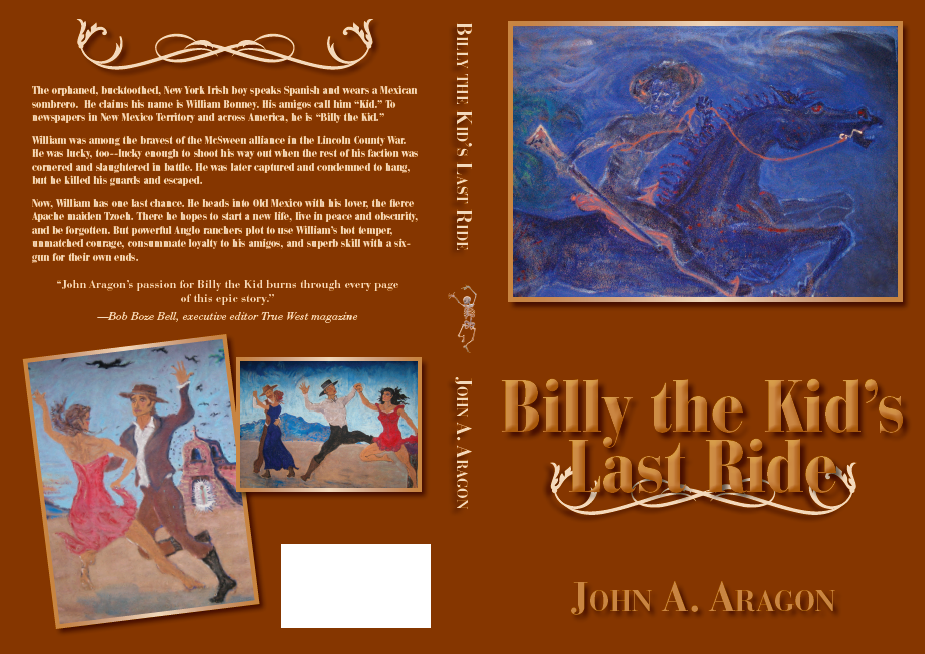
Once you have the text prepared, your cover designer will be able to help you compose a back cover layout that complements the design of the front cover and the spine. For a great example of this, check out the layout (and the design!) Jeff created for John A. Aragon’s first novel: Billy The Kid’s Last Ride
(Sunstone Press). The images on the cover are from John’s “Last Ride” mural in Santa Fe.

It’s A Wrap! Create a really effective cover for your book – Part I

Whether your book is published by an established press or you are doing it yourself, it is important to remember that what the outside of your book looks like is the first introduction many of your readers are going to have to the content, tone and quality of your book. Like it or not, your cover will provide the foundation for all of your marketing efforts. You have spent so much time writing the text; you do not want to reduce its impact by wrapping it in a less-than-impressive cover.

If you are publishing with a traditional press, your contract may not allow you any say in the selection of the cover of your book, although many writers are now requesting that their contracts give them at least some rights in this area (if publishers are expecting writers to do most of the promotion on their own books, they should at least give them a great-looking product that they are excited to hold in their hands and celebrate on their websites, right?).

I recommend that even if you have no legal ground to stand on, if you really dislike a cover that has been designed for your book, you say so. I never liked the cover of my second novel, Bitters, and told the staff at the publishing house how I felt, but they managed to convince me I was wrong. They suggested that I was a writer and not familiar with design elements. I wasn’t wrong – the colours are putrid and the design uninteresting – and I’ve regretted not being more assertive about it ever since.

****

In the second part of this two-part post, I’m going to interview the acclaimed book-cover designer Jeff Fielder – who created the cover of the newest edition of The Woman Upstairs (it was originally published by NeWest Press and I didn’t own rights to the original cover), and is also doing the cover for my next novel, The Whole Clove Diet. He has also created great covers for a number of other writers’ books, not to mention other promo materials such as bookmarks. You can see samples on his website here. Jeff will tell us how to find and work with a book-cover designer.

Before I report on that interview, however, I want to tell you a bit about what I learned about creating book covers when I worked as editor-in-chief at Lone Pine Publishing, and what I have attempted so far in the creation of a cover for my latest novel.

When I went to work at Lone Pine Publishing, my employer and the design and sales staff taught me an important thing or two about book covers:

  1. You want the cover to accurately portray not only the content, but also the tenor and even the complexity of the book itself. As far as content, think about conveying the era, the culture, the milieu the book is set in – not necessarily by portraying these things exactly, but by communicating the sense of them. For example, if your novel is set in early 20th-century Paris, you may not need a street scene that is an exact portrayal of the streets your narrator walks along; a drawing, even abstract, that evokes the same feeling as a rainy lamplit Paris street can have the same, or even greater, impact. If you’ve written a comedy, a somber cover will not suit, and a historical saga should not look like a steampunk novel. As far as stylistic complexity, if your writing emulates that of Feodor Dostoevsky or Ayn Rand, you may not want a cover image of a couple clutched in a passionate embrace à la Harlequin Romance, no matter how passionate your characters may be. Go to a bookstore: either a real one or online, or check out collections of book cover designs like this one. Look at books in the genre and style in which you are writing. Look at their covers for inspiration and guidance and to increase your own awareness: pre-teen novels do not look like detective novels for adults; books on creating effective websites do not look like biographies; westerns do not look like zombie novels.
  2. Design styles change. This can work to your advantage. If your novel is set in the 1950s, check out the original covers of novels published in that time period: emulating them can reinforce the time-frame of your book. The fact that design styles change is also something you should think about if you want your cover to remain effective for the next twenty years: you may not want to get too trendy;
  3. You will need to make choices about the content of the cover design. Are you going to use a photograph on your cover, like this one on a bio by my friend Peter Jonker does? A painting? A drawing? Perhaps a simple colour design with text? Each of these options presents a different message to the viewer and conveys something about the content of the book;
  4. Consider costs. Can you afford to commission an actual work of art for the cover of your book? Can you even afford permission costs to use a work of art already in existence? If you want a photograph, how will you access the one you want? You CANNOT use a photo or piece of art you find on the Internet without seeking permission from the creator and/or his/her estate: it is not only unethical, it is illegal. On the other hand, if you use a free or very cheap stock photo from a do-it-yourself cover-maker page, you may run into your cover illustration on the cover of someone else’s book or other product. But if you create your own photograph or work of art – or use a drawing by your clever seven-year-old – is it going to look sufficiently professional, or merely quaint and home-made?
  5. Did you know that the font you choose for your title, author name, and back cover text, is also communicating a message about the content of your book? Did you know that fonts also go in and out of style: there are quite a few people who actually “hate” comic sans because they’ve seen it in too many PowerPoint presentations, for example, and may be turned away from reading your book just because you used that font on your cover? You many want to investigate any non-classic fonts carefully before using them – unless, of course, the funky font you’ve chosen reinforces the tone of your book;
  6. Visual contrast is crucial to a cover. You want to make sure that people can read the text on the cover of your book. White text on pale gold may look great up close, but it’s almost impossible to see when the cover gets small enough to put on a website, or even on a shelf a few yards away across a bookstore. A very busy cover may also make your title invisible to the reader;
  7. What is your cover going to do to help your sales? Is it going to attract attention when it is reproduced for review on someone’s blog at about 3 cm x 3 cm? If a bookseller puts it in a book stand, is the title still going to show? Will it reproduce well on a poster, a brochure, a postcard, a bookmark or other materials you may choose to create to produce to promote your book?
  8. Remember that a cover is a wrapper for a book. It has three sections: the front, the spine and the back. If you choose different backgrounds for those three elements, what is going to happen to the appearance if the cover is cut a little “off angle” during the production process? Is the artwork for the spine going to actually appear on the spine, or is it going to angle across the spine? It is generally best to use the same predominant colour all the way around the cover so you don’t end up with off-kilter colour where you don’t want it.

These and many other questions should occur to you as you are creating your book cover, which you can do on your own for free with programs offered by self-publishing companies like CreateSpace, or online by Googling such terms as “book cover templates.” I recently read a great suggestion that you can make a jpeg for a book cover using PowerPoint.

You can also hire a cover designer who knows what he or she is doing (which is my preference, and as important to me as hiring an outside editor) or do it yourself. But whatever course you take, make sure you love your book cover and that it is “you,” as much as your writing is.

Fernando Botero, and The Whole Clove DIET Cover

Early in the period during which I was writing The Whole Clove Diet, I saw a painting at the Johnson Museum of Art at Cornell University that opened a whole new world to me. It was by Fernando Botero, a Bolivian artist I’d never heard of at that point, and I immediately identified it with the mood I was working to convey in the novel. The subject of the drawing was a young girl – round, as most of Botero’s subjects are—and she was smoking a cigarette. She looked feisty and assertive, defiant in spite of or perhaps in part because of her shape and her age-inappropriate nicotine-delivering accessory.

As I explored further I learned that the men and women in most of Botero’s paintings and sculptures may be far over a healthy BMI but they seem not to be concerned in the least about that. If they are not flaunting their pudginess, they are at least confident in their bodies and apparently certain of who they are.

Over the years since I have sought out and found many Botero paintings and sculptures to admire both online and in real galleries. I always imagined that when I was ready to publish (I assumed at that point that the world’s major publishers would be begging at my door for The Whole Clove Diet), I would ask my publisher to approach Señor Botero and secure permission to use one of his images for the cover. I had, in fact, chosen several paintings that I would particularly have liked to use.

When I decided to pursue publication on my own, I thought at first that I would need to abandon the idea of using a Botero on my book because I did not have the heft of a publishing company behind me. But then I decided that I should leave no stone unturned, so I began a rather lengthy process of figuring out how to contact the artist. With the help of a friend, I finally figured out who Botero’s representatives were in the United States, and contacted them. They said I could make a proposal to the artist through them, and so I proceeded to carefully prepare a letter to send to them, to send to him. I gave evidence to the artist (I hoped) that I was no first-time writer, that I respected and admired his work tremendously, and that although I could not afford to pay him what it might be worth for this one-time use (which I presume would be in the thousands of dollars), I would be happy to share any amount of the cover price of the book that he might be interested in suggesting. (I would not, of course, have agreed if he’d wanted too much of the cover price!) The owner of the gallery who represented Botero was very helpful, asking for additional information I had not included and even going to all the trouble to buy and read The Woman Upstairs, my first novel.

The pitch was not ultimately successful – Fernando Botero declined to allow me permission to use his art – but I gained from the experience anyway. I acquired a fan in La Jolla California (the gallery owner, who said she liked my book and is looking forward to The Whole Clove Diet. Thank you, Mary Beth Tasende!). And even though I was disappointed that Señor Botero said “No,” I would have been even more disappointed in myself if I had not tried to reach him. I would have wondered forever if he might have said “Yes” if I had just asked. I did the best that I could do, and even though the response was not what I might have wished, at least I have it.

A couple of my friends worried that if I did get permission, some prospective readers might not like Botero’s art, and might therefore not want to buy the book. Who knows? I still love his stuff, and I think that people who love good writing are also those who love good art.

However, the message I am trying to deliver here is that as writers pursuing the new world of “independent publishing,” we need to have some chutzpah. It is no longer enough for us to just write our books. Now we need to clothe them before we send them out in public. We need invest some energy, and maybe even some money, in making our books look as good as we have made them sound.

If you have a book cover you particularly like, tell us about it in the comment and add a link. Show us what you like about it. If it’s your book, tell us why you chose it.