Need Help From Current or Prospective Grant Applicants

Update 11 p.m. Tues., Sept. 27 — Thank you for the responses so far! I am still looking for one artist (any discipline except writing — visual arts, performing arts, multimedia etc — preferred, as two writers have already volunteered) and three people involved with writing grant proposals for community groups or non-profit organizations (small to large groups/organizations welcome.)

__________________________

I am developing THREE series of audiocasts (6 in each series) based on my book, Write an Effective Funding Application: A Guide for Researchers and Scholars"" (The Johns Hopkins University Press).

The courses are being developed for three different audiences of prospective grant applicants: Researchers and Scholars, Creative Artists, and Non-Profit Organizations/Community Groups.

I have developed preview audiocasts for each of these courses and they are now available as MP3s. I am looking for people who are planning to write applications for funding in one of those three categories, and would like to listen to these preview audiocasts and tell me what you think.

If you are interested in helping, please contact me at marywwalters at marywwalters dot com (note the double W) or by responding through this website.

If you don’t like the audiocast (which is about 25 minutes long and comes as two MP3s), I win because I get to incorporate your suggestions for changes in the recordings before I “go public.” If you do like it, you win, because I will be happy to provide you with the six audiocasts that form the modules of the course at no charge as they become available — as long as you keep providing feedback on what you hear before I post them. :)

I want three “beta listeners” for each audiocast. I have two already for the researchers and scholars preview recording. I am therefore looking for

1 researcher/scholar (PhD student/candidate, PDF, assistant or associate prof etc. Any discipline)

3 creative artists (including writers, visual artists, filmmakers: anyone who would like to learn how to write an effective grant application to support their creative projects — from a foundation or other funding agency, for example)

3 people who would like to learn more about writing effective funding applications on behalf of community groups or non-profit organizations — from water polo teams to national galleries: block (operational) funding or project grants.

The series is relevant to those who are working in any geographical location where grants are available.

How writers can stop plagiarism: individually, and as a powerful, united, “pen”-wielding group

Imitation may be the sincerest form of flattery, but copying is theft. And yet stealing the writing of others has become so commonplace that teachers and professors feel impotent to put a stop to it, and many writers seem resigned to the inevitability of being ripped off, scraped, plundered, robbed and screwed.

I am not resigned. I can only begin to imagine my outrage if someone ever attaches his or her name to a story, essay or article I have written and tries to pass it off as his or her own (which has happened to many other writers but not to me yet, as far as I know). It was aggravating enough to discover that a post from this blog – which I had spent hours and hours creating (or years, it could be argued, if you consider the experience that went into it) – had been altered enough to make it hard to trace and almost unintelligible, then posted as part of a money-making machine set up by some scuzzbucket with a website registered in Russia.

Thanks to the diligence and knowledge contained within my fellowship of on-line writers, with whom I communicate at last count on about ten different sites, I managed not only to figure out who was doing this to me (and hundreds and hundreds of other writers), but also why – and what I could to do to address the problem.

How I Discovered I’d Been Pillaged

About three weeks ago, I Googled “Militant Writer” to get the link to my blog (usually I just use the autofill function on the Google toolbar but I was on another computer). To my surprise, the results included not only my site and a few unrelated items, but also a couple of links to what turned out to be mangled versions of one of my blog posts — on someone else’s website.

It turned out that the site, entitled Publish A Book, is a compilation of hundreds of articles previously published in dozens of different on-line publications – some from blogs such as my own, but others from more established commercial outlets such as The Wall Street Journal and The Washington Post. In each case every fourth or fifth word has been replaced with a synonym, most of them slightly “off,” so that the articles come out sounding as though they have been translated into a different language, and then translated back to English. One sentence in my article reproduced on the other site read, for example, “It looks unpreventable to me now that except they take up the sideline manufacture of weaponry or maybe bath salts to sponsor themselves, the major publishing homes are going down,“ while the original version was “It seems inevitable to me now that unless they take up the sideline manufacture of weaponry or bath salts to subsidize themselves, the major publishing houses are going down.”
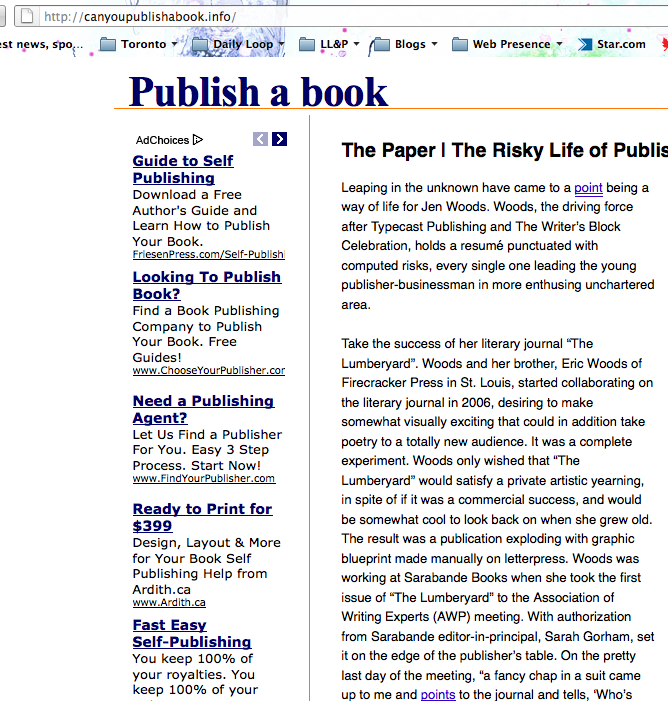
Screen capture of an article on canyoupublishabook.info

In addition to all the other articles,  I noticed that there were lots of ad links on the website but I didn’t yet understand what that meant. I looked around the site – without success – for an email address to which I could send a complaint. On July 20, I put a notice up on my blog to tell my readers what I had discovered, and I also started threads about it on FaceBook, Twitter, Google +, authonomy, the Amazon Breakthrough Novel Awards (ABNA) discussion forum, a couple of LinkedIn writers’ forums I belong to, and The Writers’ Union of Canada (TWUC) listserve. I also sent a letter to Access Copyright, which is the Canadian Copyright Licensing Agency – with which I am registered (you will notice a copyright notice on my on-line posts). I cc’d TWUC, my lawyer, and a few other people.

It was a few days before I heard back from Access Copyright, and the representative there explained that they could try to help me to get some payment for having had my work used by someone else. I said that what I wanted to do was to have my post removed from the other website, and they told me that they could not help with that.

In the meantime, my fellow writers on the forums had been working overtime. One person (thanks again, tvguy) found the email address I had been unable to locate on the website (by going to the Privacy Notice page and scrolling down, down, down) and he discovered that the same email address was also the contact address for a whole lot of other sites (there were about 80 at that point) which offered advice and guidance (and links to more ads) for people who had questions about lung cancer, loans for bad credit, migraine headaches, and a whole lot of other conditions and issues. Another writer helped me by tracking the websites and the email address to an internet host which included an actual name and functioning email address, albeit one located in Vladivostok (which didn’t sound like a place that was going to honour my copyright).

Another writer colleague explained the rationale for all those sites – and the dozens of others like them that are proliferating on the Internet. He explained that these larcenists set them up to attract hits by people using search engines to look for information on certain popular topics – in this case, self-publishing. When unsuspecting visitors to these sites click on one of the many links contained within them, the owner of the site gets a payment – from Google AdSense or similar advertising programs. They probably get only a few pennies when someone hits one link, but when you have 80 sites and hundreds of links, they start to add up.

In the meantime, I had been going through the perpetrator’s websites attempting to work backwards to identify others who were, like me, being victimized by the owner of these websites (if you are looking for a new way to procrastinate on the Net, there is meaty potential here. The articles become puzzles that you can solve by trying to guess what word was in the article originally before they replaced it with a less meaningful synonym, then Google the result and see what happens). I guess I was thinking of “class action” remedies to the problem – if enough of us who had been wronged complained together, perhaps we could get the sites taken down.

I found the originals of several articles – including a few from blogs and some by writers for the New York Times, Wall Street Journal and Toronto Star. I wrote to these latter writers, and ultimately to the papers themselves to tell them what was happening. (In response, I have had one “Thanks for the heads’ up” response from the WSJ, but that is all.)

What I Did

Despite really significant support from the writers on the aforementioned forums and this blog page (“Go get the slime, Mary,” was a typical response) and their excellent sleuthing skills (thank you, people), in light of the lack of interest exhibited by almost everyone I had written to directly, I lowered my expectations. I did have other things to do besides bringing down one scumbag. I decided I would settle for having my own blog post removed from his website, and alerting other people as to how I had done it.

On August 8, I sent the “Cease and Desist” letter I posted on the same day on my Militant Writer blog. I sent it to the email address that was posted on the “Privacy Policy” page of all those websites (which turned out to be a non-functional email address) and to the email address that was listed on the site where ownership of the website was listed (which seems to have been working). I sent a copy to Google AdSense (which required me to walk over to the FedEx office several blocks away and spend $12 to fax it, since Google and Google AdSense don’t have email contact addresses. Which makes me laugh). I sent copies to my lawyers in Canada and the USA, and to the papers to which I had previously written whose work had also been plagiarized.

Even though it was a big hassle to go and fax the letter to Google AdSense, I think that was the step that brought results. Google is based in a country that does have copyright laws, even if the plagiarist is not. (I have since heard that the perpetrator might not be just one person – that businesses to set up advertising-money-generating websites are popping up all over the Middle East and Asia, employing hundreds of workers at $1/hour to comb through articles in western newspapers, magazines, and blogs, alter them, and post them on these money-making websites. Others have suggested that the perpetrators use complex computer algorithms rather than slave labour.) It seems unlikely to me that Google is going to want to be seen as knowingly paying someone on the basis of stolen copyrighted text.

Whether it was the fax to Google AdSense or the email to the website owner, all of the articles I had pointed out had disappeared off the websites by the following morning (not only mine, but the examples I had provided from the NYT and the WSJ). The sites are still up, although there seem to be fewer associated with the fake email address grishina@addictiontreatmentinfo.net,  which leads me to believe only that there are probably now sites with a whole new fake email contact address on them. But it is time for me to get back to my own work.

What To Do If You Are Plagiarized

  1. Make screen captures (Command, Shift, 3 on a Mac) so that you have evidence of what has been posted and where it was copied from, with date stamps;
  2. Write a cease-and-desist letter (like the one I wrote) to the person who has done the plagiarizing. Use any contact addresses on the site to track down the legal owner of the site, or try http://who.is/

If you want to start strong – or with your followup email if the first one doesn’t work – send copies to:

  • the site’s web host if you can find it (e.g., if the name on the site is scuzzbucket at yahoo.com, send a copy to Yahoo);
  • any commercial interests that the plagiarist is working with via links or other promotional initiatives;
  • legal representation in the country where the commercial interests are based;
  • the media.

If that doesn’t work, then:

  1. If any of the stakeholders are based in the U.S., send the website a Digital Millennium Copyright Act (DMCA) takedown notice. The act is explained on Wikipedia and this WordPress site gives excellent guidance on how to complete a notice: http://en.support.wordpress.com/content-theft-what-to-do/
  2. Advise the Internet Corporation for Assigned Names and Numbers (ICANN. Note: I didn’t get around to exploring their site so I’m not sure if they have any interest or power in this area)
  3. If you still don’t get results and you can afford it, sue the bastards. If you can’t afford it, try to gather a group of other writers together whose copyright is being infringed by the same website owner, and put your resources together or find a pro bono legal service to help you to sue the bastards

Attitude Attitude Attitude

The important thing, as far as I’m concerned, is that we don’t just accept that plagiarism is the new reality. If anyone in the universe should be able to fight back eloquently and passionately against the theft of our writing, it is writers.

We can prove that the pen is mightier than the sword, and if we are fortunate (as I was) we can use our words to diffuse the problem before we have to start paying lawyers. Sending a copy to a lawyer is a good preliminary indication of your serious intent, however, as far as I’m concerned.

For many of us, our writing is our stock-in-trade. Most of us aren’t making very much money from doing it, but we invest a lot of time, thought and heart into what we write, and if our work is stolen and we don’t speak up, we are devaluing what we do.

We need to constantly remind our students and our readers that plagiarism is theft. We need to be familiar with, support and monitor the copyright legislation that affects us. We need to join copyright collectives like Access Copyright and post copyright notices on our work. (I am not a copyright lawyer, but I do know that you don’t need to pay to copyright everything you write in order to protect it. If you have evidence you wrote it — as I do here with my early drafts of this blog post on my computer — you are covered.)

We need to make a BIG, FOCUSED, ARTICULATE NOISE when someone rips us off, or steals the work of any of our fellow writers. We, both individually and as a group, hold the strongest weapon there is against the theft of our creative enterprise: our own eloquence. It is up to us to use it.

P.S. I welcome comments that include any additional information you may have on fighting copyright infringement. And stay tuned — I WILL be getting back to the important subject of self-publishing very soon, as I move closer to publishing The Whole Clove Diet.

Note: If you want information on how to detect plagiarism, or where to find plagiarism-detection apps, visit this blog post by Jennifer Murtoff. And tvguy, mentioned above, has found a way to warn off prospective plagiarists before they even start.

Dear Plagiarist/Vile Wretch/Scumbag

Update: On Tuesday, August 9, the stolen and mangled articles I linked to in this blog post were removed from the sites associated with the grishina email address. I suspect this had more to do with the copy of the letter I faxed to Google AdSense than to the letter I sent by email to the perpetrator (with copies to all and sundry). I will write a blog post soon about what I did — and what steps I would have taken if this step had not worked. For now I am just pleased to see that a letter does work (power to the pen!), and relieved that it was not necessary to hire a battery of lawyers to achieve my goal.


To: grishina@theaddictiontreatment.info *

Copy faxed to Google AdSense Violations.

Additional copies sent to: The New York Times, Toronto Star, my legal representatives in Canada and the U.S., Access Copyright, The Writers Union of Canada

Subject: You are stealing my work. Please stop immediately.

Dear Grishina:

You have posted at least two of my blog posts on two of your 50 or more websites. You have riddled my text with links to Google AdSense ads and other commercial entities. It is my understanding that when unsuspecting people come to your site for information for their problems or answers to their questions and click on one of those links, you get a payment.

I don’t imagine you get paid much for each click, Grishina, but whatever you do earn from these articles of mine is more than I have earned from them—and it took me days and days to create them: thinking, writing, revising, researching, selecting the exact right words and phrases to communicate what I wanted to say. All you did was set a computer to work, crawling the Internet for articles that might fit into one of your “topical” websites, copying the articles, replacing every fourth or fifth word with a happenstance synonym so that plagiarism search programs won’t find you, stripping off the name of the author, and then posting the resulting text as if it were owned by you on one of your many sites.

You have posted the articles you have stolen from me on at least two of your websites that purportedly offer information about writing and publishing. You have stolen additional material for those sites from dozens of other writers and bloggers as well.

But that’s just the beginning, isn’t it? You have also stolen the writing that you have posted on other of your sites to attract people who are looking for information about such subjects as:

You have stolen from magazines, newspapers, community group newsletters, online health sites, and hundreds and hundreds of other sources. Every single piece you stole was written by a writer – some of us professional, some not. None of us gets paid well when we create information that is directly useful to others, and most of us from whom you have stolen do not get paid at all.

You have chosen our articles to steal because of the key words in them that, when posted on your site, will help you rise to the top of search engines when people are looking for answers to their problems – some of them life-and-death problems – so that more people will click on the ads you have inserted into our work and earn you a few pennies.

“Plagiarist” and “thief” are only two of the words that apply to people like you.

I am attaching screen captures of just two pages of Google searches that I have found this morning with your return email address on them. How many clicks from all over the world have they provided you today? What you have stolen from me may add up to mere pennies in your pocket, but I’m sure the return on what you have stolen from all of us together is more significant. And even if you are earning no money from us, you have still plagiarized our work, and that is theft.

Here is one paragraph from a post on my Militant Writer blog that you have transformed for your use:  This is your version at http://canyoupublishabook.info/the-author-as-publisher-the-militant-writer/

It looks unpreventable to me now that except they take up the sideline manufacture of weaponry or maybe bath salts to sponsor themselves, the major publishing homes are going down. There’ll surely be a part for niche publishers in future (literary presses that concentrate on poetry or maybe esoteric fiction amongst them, teetering on the edge of ending as they constantly have, and non-fiction homes that focus on such restricted regions as the plants and creatures of Paraguay or maybe the struggles of Planet War II), however for almost all mainstream fiction and non-fiction book writers, autonomous publishing will shortly end up being the norm.

This is what I originally wrote, at https://maryww.wordpress.com/2011/07/16/how-much-more-do-you-really-earn-when-you-self-publish/

It seems inevitable to me now that unless they take up the sideline manufacture of weaponry or bath salts to subsidize themselves, the major publishing houses are going down. There will certainly be a role for niche publishers in future (literary presses that focus on poetry or esoteric fiction among them, teetering on the brink of expiration as they always have, and non-fiction houses that specialize in such limited areas as the flora and fauna of Paraguay or the battles of World War II), but for the majority of mainstream fiction and non-fiction book writers, independent publishing will soon become the norm.

Here is an example of an article you have stolen from The New York Times and posted, slightly changed, on your “Early Signs of Lung Cancer” site at http://earlysignsoflungcancer.info/costello-loses-battle-with-lung-cancer-thechronicleherald-ca/

Billy Costello, who ended up being an undefeated light welterweight champion in the mid-Nineteen Eighties regardless of not putting on boxing gloves till he was Nineteen, died June Twenty Nine in Kingston, N.Y. He was Fifty Five. The cause was lung cancer, said his woman, Dolores Costello.

The original, on http://www.nytimes.com/2011/07/02/sports/billy-costello-who-won-light-welterweight-crown-dies-at-55.html?_r=1

Billy Costello, who overcame a troubled youth to become an undefeated light welterweight champion in the mid-1980s despite not putting on boxing gloves until he was 19, died Wednesday in Kingston, N.Y. He was 55. The cause was lung cancer, said his mother, Dolores Costello.

Here is one from The Toronto Star, republished on your “What Is High Blood Pressure” site at http://whatishighbloodpressure.info/reducing-salt-no-cure-all-new-study-suggests-toronto-star/

A recently published assessment implies there’s no indication that temperately cutting back on the quantity of sodium in the every day meal plan — not just salt from the shaker though also the stuff poured in processed meals — decreases the danger of developing heart ailment or perhaps dying before the time.

The regular study by British scientists working for the Cochrane Partnership, a non-profit organization that takes a second look at the indication after medical care, published in the American Journal of Blood Pressure on Wednesday concluded that lessening salt does result in a slight decrease in hypertension however had no effect on coronary disease.

Compare to the original at http://www.thestar.com/news/canada/politics/article/1020928–reducing-salt-no-cure-all-new-study-suggests

A newly published analysis suggests there is no evidence that moderately cutting back on the amount of sodium in the daily diet — not just salt from the shaker but also the stuff poured into processed foods — reduces the risk of developing heart disease or dying before your time.

The systematic review by British researchers working for the Cochrane Collaboration, a non-profit organization that takes a second look at the evidence behind health care, published in the American Journal of Hypertension on Wednesday concluded that reducing salt does lead to a slight decrease in blood pressure but had no effect on cardiovascular disease.

Plagiarism is theft, Grishina. I have a copyright notice on my blogs, but even if I didn’t, you have stolen what I have done. I insist you take down my writing from your sites immediately and never steal anything of mine again. I have copied this letter to my legal representatives in Canada and the U.S.A., as well as to the Canada Copyright Licensing Agency and The Writers Union of Canada.
Thank you for your immediate compliance.

Mary W. Walters

______________

Note: many thanks to my on-line friends on The Writers’ Union of Canada listserve, the Amazon Breakthrough Novel Awards forum, the authonomy forum, and readers of this blog, who helped me figure out who was doing this and why after I found my mangled text on-line. Special thanks to ABNA super-sleuths tvguy who found the perpetrator’s email address and showed me how to find his ISP, and Simon N Schuster who led me to this link: http://rising.blackstar.com/how-to-send-a-dmca-takedown-notice.html.

* The email I sent to the email address that the plagiarist puts on his “Privacy Policy” page does not work, by the way. The emails are returned with a “permanent failure” notice. Quelle surprise.

My blog posts are being plagiarized —

Check out this site I found today with my material from a recent post on The Militant Writer, only marginally changed, reproduced without credit:

http://canyoupublishabook.info/the-author-as-publisher-the-militant-writer/

Compare it to my original post.

https://maryww.wordpress.com/2011/05/30/the-author-as-publisher/

Hundreds of other articles by other people have been stolen — just click on the right margin.

They even have a warning privacy policy that they know who is reading “their” stuff.

I’m looking into this but if you know anything about what is happening here, please let me know.

More to come….

How much more do you really earn when you self-publish?

(Third in a series of articles about the new realities for writers and readers. In this post, I attempt to compare the relative costs and potential profits of self-publishing versus traditional publishing, and explain which method of self-publication I have chosen for my next novel, The Whole Clove Diet – and why I have chosen it.) (Of course, none of us is really interested in making money from our writing, right? We are only interested in making art. ♬ )

It seems as though every time I go onto the Internet these days, I stumble over another post in which some author is enthusing over how much more he or she is making per copy on a self-published book (70% of the cover price or more) than he or she would have made with an established press (where a 10 to 15% royalty is the norm). Somewhere on The Militant Writer, I may even have crowed about this advantage of self-publishing myself. :)

While such statements may be accurate in absolute terms, they fail to take into account many of the costs outside of printing that are incurred by traditional publishers on behalf of authors’ books. Some established presses invest more than others (and some seem to invest next to nothing) in such make-or-break areas of book production as editing, cover and layout design, and promotion and marketing, but whether they are effective or not at what they do, publishers incur overhead costs with each title.

Many of these same costs are also incurred by self-published authors—or should be—but the authors may overlook them when they are calculating their final “take” from sales.

Self-published authors who fail to make their books look and read like something besides draft manuscripts that have been laid out at home and then slapped with amateur-looking covers are (in my opinion) fools. However, as soon as we start putting money into improving the quality and impact of our self-published books, the longer it takes for us to recoup the money we’ve invested. We cannot claim we are “making 70% of the cover price” of our books until we have paid ourselves back for our expenditures to produce them.

The biggest financial difference between having a book published by a traditional press and doing it ourselves is who pays the overhead, what the overhead entails, and how the proceeds are shared. In this post, I am going to take a stab at evaluating the relative costs of self-publishing versus traditional publishing, but keep in mind that attempting to compare the two approaches can be like weighing “apples” against “all citrus fruits,” due to the variety of publishing models that have begun to proliferate.

I encourage readers of this post who have self-published (aka “indie-published”) their books, participated in shared-expense publishing initiatives, or have info about traditional publishing that I may have overlooked here, to contribute to the comments section of this discussion.

No Money Down: Working With Traditional Publishers

When a traditional publisher offers to publish your book, you do not need to contribute any money. By inviting you to give them the publishing rights to your book, publishers are essentially saying that they believe that they are going to sell enough copies of your book to make up for the costs they will incur up front in order to get it to the marketplace – and then, they hope, make a profit by selling even more.

The costs traditional publishers incur are outlined in my “Authors and Publishers” post and they include:

  • copyediting and substantive editing
  • book interior design
  • cover design
  • layout
  • printing
  • promotion
  • sales
  • distribution
  • storage
  • overhead costs – these range from the rent, utilities, etc. that are part of the costs of maintaining an office and a staff (including executive editors who will read your manuscript in the first place—or pay someone to send you a form rejection letter—salespeople who go out to bookstores to talk up your book, promotions staff, art department staff, bookkeepers, shipping and receiving staff), operating a warehouse, paying the fees of freelancers, selling other (foreign, movie) rights to your book, legal, financial and accounting costs, costs associated with creating a catalogue, posters and other promotional materials, securing ISBNs and Books in Print notifications, etc., etc., etc.

If a press publishes 20 books a year and its annual expenses are $1 million, one could argue that each book costs the company around $50,000. Of course this is a vast oversimplification because books that were published in previous years that sell this year bring in income that helps to sustain the business, operating grants may be involved, or subsidies from institutions such as universities, funding may have been secured to help with marketing and promotion, and there are many other factors that need to be considered. So let us say that the cost of producing 5,000 copies of your book is $20,000.

Let us also say that the book thus created is going to sell for $20.

In that case, on each book:

  • You, the author, will receive about $3 (depending on royalty rates that are set out in your contract);
  • The booksellers will keep about 40% of the amount they receive for the books they sell, or $8;
  • The publisher will retain the remaining $9.

As you have already figured out, these numbers show that in order to pay itself back for the costs it has incurred, the publisher needs to sell nearly 2,500 copies of your book— half of the stock it printed – just to break even. Even after that, additional promotion, storage of unsold books, and other costs are going to need to be deducted from the publishers’ portion of the income from each book.

In this scenario, the author starts to make his or her paltry $3/copy from the first copy that is sold – although the author’s actual receipt of those $3 pieces is subject to such factors as:

  • Advances: The amount that has been advanced to you by the publisher must be reached before you will receive any more money. If the publisher advanced you $3,000 in our example, for example, since you are making $3/book you will not start earning any more money from royalties until after 1,000 copies of your book have sold;
  • Agents: If you have an agent, he or she will receive a cut of your take: let us say 15% of $3 =  45 cents, leaving you with $2.55. (This is why agents are only interested in working with writers who have the potential to sell a lot of books.);
  • Returns: The traditional book business is unlike almost any other business in that bookstores can return the products (books) they do not sell to the manufacturers (publishers). Your book is not sold when it is stocked by a bookseller, but only when it is purchased from the bookseller.

Costs to Self-Publish

The costs of self-publishing, by contrast, are entirely dependent on who the writer deals with, and what costs beyond book production (e-book and/or print version) he or she chooses to incur.

The Rip-Off Artists

Let us dispense first with the companies that advertise on-line that even though they accept every book that is submitted to them, they are still traditional publishers because they will give you an advance and publish your book at no cost to you. Closer examination of these companies (and reviews from those who’ve used them) indicate that the advances are minimal ($50 or so), the printed copies are expensive (e.g., $20 to $25 or more), the “publishers” often do not make any real effort to get the books into major sales outlets (including onto Amazon), there is no e-book option, and the major thrust of such companies is to hard-sell copies to the authors. (In one contract I read on-line, the company assures authors that review copies will be distributed, but only to reviewers who write to the company asking for a copy of your book. How many independent, respected reviewers do you think you can convince to write to your publisher and ask them for a book? It isn’t going to happen.)

Similar methods were used by what is known as “vanity” presses in the past: they offered you “free publishing” as long as you agreed to buy 1,000 copies of the finished book, which of course you would then need to sell yourself. People invested huge amounts of money in such scams and ended up with hundreds and hundreds of copies of unsellable books in their basements. In this era of print-on-demand, you don’t need to buy all those copies up front, but the principle is the same: the only entity that makes any money off such ventures is the “publishing” company.

Some other companies have recently been created that are in the e-books-only business. They also offer publication at no cost to you, but they spend almost nothing anyway: all they really do is pour your text into a file, slap a cover image on it, and then put the book up on the Internet. No real editing, no significant effort to market your book, no real investment on their part. They then stand back and simply take a cut of whatever sales you are able to drum up.

Check the fine print in the contract with any self-publishing enterprise as closely as you would (or should) with any other venture in which you have chosen to participate. If it sounds too good to be true, it probably is. Ask to see what the publisher is prepared to do to help promote your book (and then make sure they do it), seriously consider the books it is already offering and determine whether you want to be associated with those books and authors, and Google to find if there are any negative comments about them from authors who have used them in the past. Keep in mind that the testimonials that appear on the “publisher” websites are those that have been pre-approved, and even their on-line forums may be censored to weed out negative feedback.

In other words, caveat emptor.

Bare Bones Self-Publishing

The lowest cost I have found to self-publish a book with a reputable company is $299. With this very basic option, the author provides all text pages and the cover in “camera-ready” PDF format so that the publishing outlet doesn’t need to do anything but assemble the book on a computer so that it is ready to be printed, one copy at a time (known as “print on demand,” or POD), whenever anyone orders it. An example of this basic service is the CreateSpace Author’s Express, and CreateSpace also offers a slightly enhanced version of its basic package that provides you with a template for the interior and the covers, and costs $499. It is called the Author’s Advantage.

(Note: I am using CreateSpace not only for my examples in this post but also for my book production because of that company’s close association with Amazon. A book produced by CreateSpace is not likely to encounter any problems entering Amazon’s distribution system. I know that Amazon has created a monopoly that is taking down all competitors, including lots of mom-and-pop bookstore operations, and I’m sorry. However, with my little novel I cannot afford to become a one-person protest movement any more than I already am: I need my book to be available everywhere, as soon as I publish it.)

The Cadillacs of Self-Publishing

At the opposite end of the spectrum, those who want to buy a publishing package that already includes all the bells and whistles, in the hope (probably erroneous, but who knows?) that they will need to do no work at all to make their books bestsellers, may choose an option like the Total Design Freedom Marketing Pro from CreateSpace, which sells for $4,999.

For this price, the author receives two rounds of copyediting, which CreateSpace estimates to be worth just over $1,000 per round, a custom-designed interior ($499) and custom book-cover design ($999), a video book trailer ($1,249), promotional-text creation ($249), assistance with the creation and distribution of a media release ($598), and registration for a Library of Congress Control Number (LCCN), which allows libraries to catalogue your book correctly if they buy it, but does not guarantee that they will buy it ($75). (This is a worthwhile investment, as far as I’m concerned.)

Options In Between

CreateSpace offers a variety of packages that range in cost between the Author’s Express and the Total Design Freedom Marketing Pro, and other companies (LuLu, for example. Update: Comment linked here says there are no costs at all with LuLu if you’re prepared to do all the work yourself) offer similar ranges of packages. These companies also offer a range of royalties on each copy sold, depending on the agreed-upon forms of distribution and other factors.

The various expenses and reimbursement options can be found on the companies’ websites, although sometimes you need to trade your email address for specific details. When you look at their charts and numbers and offerings of royalties, it is very important to remember that your profit does not begin until you have paid yourself back for what you have invested to get the book published.

Most writers will decide that there are some aspects of book production and promotion that they can do themselves, or that they want to hire people they know to carry out certain functions, and they will choose a publishing package that allows them to incorporate the options they have chosen to do independently with the services for which they require direct assistance. If you use outside services to complement the package you have purchased, the costs of these too need to be added into what you pay back to yourself before you can start to look at profits.

How Much Will You Make?

On this page at CreateSpace you can start to estimate the royalties you are going to make on the book you have created.

In order to compare your profit as a self-published writer to the model I set up to illustrate the disbursements to you by a traditional publisher, let us say your self-published book is also going to be marketed at $20 per copy. ($20 is quite a lot to charge for a POD book, because [at least at this point in the history of publishing] no matter what you do, the quality of a print-on-demand book is not going to match that of a book produced on an off-set printer running 500 to 2,000 copies at a time or more; however, for the sake of argument we will leave the price there so that comparison is possible.)

Let us say that this book is 120 pages in length, and the trim size is 5½ by 8½ inches. (Page count and trim size are important matters that you will need to take into consideration when you are publishing your book. So is paper weight, cover quality, etc.) The royalty that will accrue to you from this set-up if your book is sold on amazon.com (depending on various options you have chosen) is just over $8/copy. (The chart says you can make 50% more if you set up your own e-store with Amazon, but I haven’t even considered that: I could be wrong, but it sounds like a lot of work.)

If you have chosen the basic package from CreateSpace ($299), at $8 a piece, you will need to sell 38 copies of your book before you will start to earn any income from it. If you have purchased any additional services, from typesetting to cover design to marketing, either from CreateSpace or individual suppliers, you will need to add those amounts to the $299 before you can start counting profits. And if you went with the Total Design Freedom Marketing Pro from CreateSpace at nearly $5,000,  you will need to sell 625 copies before you start to see a profit.

The Whole Clove Diet: The Option I Am Choosing – And Why

I don’t want to spend any more than I need to on bringing my new novel, The Whole Clove Diet, to market. However, I want to be proud of how it looks because I think it’s a good novel (funny, and other good things as well), and I spent a lot of time writing it. I have also paid to have it edited, and I want it to look professionally produced so I can market it with confidence.

My experience as editor-in-chief at a publishing company, and work I’ve done since as a freelance production manager of books, newsletters and other publications, have taught me that it is not a wise investment of my time to even try to typeset my own book. Typesetting requires specific skills, knowledge and experience in order to ensure that pages look professional and avoid common errors (such as widows and orphans—do you even know what those are?) that instantly tell the reader that a book is self-published.

I believe that the price offered by CreateSpace to typeset books is reasonable, so I am going to use them for the typesetting part of the production. I will work with them to decide how the typesetting should look (what font, what the running head will look like, etc.), but they will do the work.

I also know I am incapable of creating my own book cover, although I want to have a lot of input into what that looks like, too. I have worked with a book cover designer in the past (Jeff Fielder) and I want to work with him again, so I am going to pay him to provide a custom cover for my book, which he will submit to CreateSpace in the format they require. Hiring an artist/designer for a book can run anywhere from about $500 and up, depending on the experience, knowledge and reputation of the designer and what you want him or her to do. (CreateSpace offers this service at $999 if you buy it from them.) You may also need to pay for cover art or photographs that are included in the cover.

I’ve paid my editors, and I am going to pay for my own marketing, including promotional copy, a video trailer (if I decide to use one), sending out review copies, and other promotional activities. Some of these tasks I will do myself; for others, I will hire other people.

I am therefore choosing a package offered by CreateSpace for $499 in which they will do the typesetting, and I will be responsible for the rest. I will send them the edited text in a Word document, and the cover I have had designed by my friend. They will do the layout, send me a proof to check over, and then make the book available for sale in both Kindle and POD formats. (Kindle conversion is normally $69 but I took advantage of a special offer from Amazon that was available when I placed the order for my book.) I have paid an additional $75 to obtain an LCCN.

Note in all cases that there is an extra charge for illustrations, photos, charts and other visuals included in the book.

Other Options Besides Self-Publishing

In addition to straightforward self-publishing packages, a host of other publishing models are now available, thanks to the opportunities for POD and e-books that are offered by the new digital technologies.

A number of collective approaches to publishing are out there, for example. Some, such as ShelfStealers which is the brainstorm of my friend Sheryl Dunn and her colleagues, have a strict editorial process that ensures the quality of books they are publishing.  The company does the cover design, layout and some of the promotion, and offers authors 50% gross royalties on audio and e-books, and 50% of net on print books less the cost of book (approximately $5.50 each).

Other coop companies involve authors to a greater or lesser extent in the publishing process, and royalties are related to the contribution the author makes. There is certainly something to be said for publishing as part of a collective—a group of books is better able to attract attention than a single book, and it is often easier to promote someone else’s book or a group of books of which yours is a part than it is to promote your own book. These collectives do not necessarily make you eligible for consideration in awards programs or by writers organizations, reviewers or bookstores who require “traditional publishing” status before they will even consider you or your book, so be sure you know what benefits you will gain from participating in such cooperatives, and how much time and energy you will need to invest, before you sign anything. There are lots of writers in this world who no longer have time to write because of commitments they’ve made to help get other people published.

In order to stay in business, some established publishers are also now offering co-publishing agreements to writers. The publishers do the same things they have always done for the books they publish (editorial, layout, design, distribution, etc.), but the authors contribute several thousands of dollars up-front to the overhead, and their royalties reflect the fact that they are essentially co-publishers. The authors get the cachet of the publisher’s imprint, but this can be an even more expensive alternative than self-publishing.

Reprinting Your Out-of-Print Books

For the information of those who are considering self-publishing books that have gone out of print – here is my experience.

I had my novel The Woman Upstairs, which was well reviewed and won an award for excellence in writing but had been out of print for twenty years, reprinted by CreateSpace. Since I didn’t own the rights to the original cover or its artwork, and I wanted to revise the cover text, I had new cover made and paid for that separately.

I paid $191 to have the book scanned (5 ½ x 8 ½ in., approx. 120 pages) by CreateSpace. I paid $69 for Kindle Conversion. I needed to pay an additional $50 because I changed the copyright page to reflect the new ISBN, my current name, the LCCN, etc. I also paid $75 for the LCCN.

So for less than $800, my first novel is now available in both print-on-demand and e-book formats. Now all I have to do is sell about 160 copies to recoup my costs. :)

Note: If the book that you want to reprint—or create—is in a non-standard format or requires special layout or certain types of paper, such as poetry, children’s books or art books, some specialists are now making their services available to help you prepare your book for self-publication. Two examples that I know of are so far in these areas are Really Love Your Book in the U.K., and Blurb.

So there you have it — all I  know about the costs of publishing a book, and perhaps more than even you wanted to know. The time it took me to write this post would probably have been more profitably invested in moving The Whole Clove Diet closer to being ready to submit to CreateSpace. But since I am investigating these issues for my own purposes anyway, I figure I might as well share what I find out. I hope you will find something of use here — and please do add your own experiences with publishing by way of comments, for the benefit of others. (Update: Note the positive feedback re: Lightning Source in the comments.)

Mary’s Writing and Publishing Browsery for June 14 2011

Here is an (annotated, of course: I rarely keep my opinions to myself) accumulation of interesting items about writing and publishing that I’ve come across (or been referred to by others) in the past few weeks:

  • For the inside track on the appalling impact of previous sales figures on book-publishing decisions, check out Steven Henighan’s amazing article “The BookNet Dictatorship” in Geist. If you’re a mid-list writer who can’t get an agent or publisher to read your manuscript, maybe this is why. And this happens everywhere – in the UK and US, for example, as well as in Canada;
  • In this YouTube video, Margaret Atwood displays her drawing talents in a presentation to the O’Reilly Tools of Change for Publishing Conference in New York in February. I love her “Change Isn’t Good For Everyone” slide in particular (it is so Atwoodesque), but I think the half-empty glass she sees may also be viewed as half full it. Many of the problems she raises re: technology and books are caused by publishers, not by technology, and imho the structure that links writers (and editors!) inextricably with publishers and agents is already outdated. The United Artists model she suggests is relevant, and many groups of “indie-minded” writers are now banding together to apply that model to books;
  • Unbound is an independent publishing initiative where interested readers can pledge financial support to bring a writer’s work to press, helping to support the writing process of specific books in exchange for rewards such as lunch with the author and a mention in the acknowledgements (Kickstarter is a similar initiative that encompasses the range of creative projects.);
  • An item in Business Insider, “This 26-Year-Old Is Making Millions Cutting Out Traditional Publishers With Amazon Kindle,” profiles Amanda Hocking, the young author who is fulfilling the wildest dreams of legions of self-published writers by selling hundreds of thousands of her books and keeping 70% of the profits;
  • Another Business Insider article, “Suddenly, Amazon Starts Competing With Its Biggest Suppliers,” introduces Amazon’s latest initiative: its own publishing division. As fellow Writers Union member Art Slade pointed out, perhaps this will encourage other publishers to pay their authors more of (their own) money on electronic books. Otherwise, to me—an author who is looking with interest at the stripped-down model of getting good books to readers in which publishers are superfluous—this move by Amazon makes no sense.  Why not add an editing imprint, rather than a publishing imprint??
  • Finally, to mid-list author Neal Pollack’s article in the New York Times, “The Case for Self-Publishing,” I can only say “amen.”

For those who are not familiar with The Militant Writer blog, I direct your attention to two of my own recent articles: “As Publishers, Agents and Booksellers (unfortunately) (for them) Go The Way of the Dodo, Writers Learn To Fly” and “The Author as Publisher.” More articles in this series will follow as I have time to write them.

In the meantime, I encourage you to let me know if you see items on book publishing and writing that might be of interest for future Browsery columns. You can email me at marywwalters at marywwalters.com

Thanks for leads to the articles in this edition of The Browsery from Larry Anderson, Dwight Okita, Gerry Riskin, Marion Stein and a panelist at a Writers Union forum whose name eludes me.

The Author as Publisher

(Second in a series of articles about the new realities for writers and readers.)

It seems inevitable to me now that unless they take up the sideline manufacture of weaponry or bath salts to subsidize themselves, the major publishing houses are going down. There will certainly be a role for niche publishers in future (literary presses that focus on poetry or esoteric fiction among them, teetering on the brink of expiration as they always have, and non-fiction houses that specialize in such limited areas as the flora and fauna of Paraguay or the battles of World War II), but for the majority of mainstream fiction and non-fiction book writers, independent publishing will soon become the norm.

In this post, I examine the “services” publishers have traditionally provided to writers and their books (and therefore to readers, I suppose), and then I look at how I believe these same functions can be managed—often in a more effective manner—by the authors themselves when they publish their own books. The post examines five specific areas:

  • manuscript selection
  • editing
  • production
  • promotion/sales
  • distribution

There are other areas that publishers have traditionally managed for writers, often with the help of agents. Most of them relate to subsidiary rights—e.g., translation rights,  dramatic rights, merchandizing rights, and so on. Publishers have traditionally taken a chunk of the money that accrues when a book has been translated or made into a movie. They have argued (with good reason) that after a manuscript has been accepted by a publisher and turned into an attractive book, it becomes more appealing to rights purchasers. Publishers have at times facilitated the process by presenting their books to prospective foreign publishers at the London and Frankfurt book fairs, for example, but for the most part they have simply secured some portion of the subsidiary rights without actually doing much to encourage an income flow for either themselves or the author from such sources.

So, on to the “services” they have offered and fulfilled.

 Manuscript Selection

Looking Back

Most readers and many publishers have always believed that publishers performed an invaluable role in the book-production process by making the initial selection from the thousands of manuscripts that were submitted to them every year of the books that would reach the marketplace. These selections were made, at least ideally, and perhaps twenty years and more ago, on the basis of writing quality, uniqueness of voice, and a variety of other subjective criteria that only highly trained, well read, passionate, experienced and discerning editors could make.

However, publishing companies have realized increasingly in the past decade that they are businesses. Senior bean counters have required the editorial departments to make decisions about which books to publish on the basis of how many copies of those books are likely to sell. Sales departments have increasingly had veto power over book selection . . .  and the sales department of a publishing house is itself directed in large measure by the buyers for the major booksellers, who are the ones who ultimately choose which books are going to end up on the shelves.

To attempt to ensure sales, publishers release books that are just like the books that sold like hotcakes last year—hence the proliferation in recent years of vampire books and in future years, I am guessing, of detective stories starring androgynous computer geeks with photographic memories. They also want books that are written by people whose last books sold like hotcakes. When publishers do pick up a new writer, they want her or him to be sexy, well-spoken and distinctive. Sometimes they will even go and get her, if she is famous enough: watch for the book by Lady Gaga which is sure to be out soon.

The days when literate editors fell in love with new literary voices and argued successfully to publish their books is long gone. If there is no research evidence (i.e., last year’s sales figures) to justify the company’s taking on a book, it isn’t going to happen.

In the initial post on this blog (“How Literary Agents Are Destroying Literature…”), and in others since, I have described at length how the book selection process is skewed away from quality literature and toward shlock. For additional and truly eye-opening discussion of how books are selected for publication, I also direct all readers, and particularly mid-list writers, to an article by Stephen Henighan that appeared in Geist –“The BookNet Dictatorship” — which discusses how book-sales data affect the selection of book manuscripts for publication (the article is about the Canadian industry, but the same system applies where you live).

Looking Ahead

In the brave new world of publishing, the worthwhile books (and the standard for what is “worthwhile” has infinite variation) are selected after they are published. The sorting is done by the readers and reviewers. They are the ones who decide which books will be popular and critical successes. No more gatekeepers who are “more knowledgeable” than readers about which books will sell, or even be of interest. If a book has an audience of three, now it will find that audience: and a few other people might pick it up as well.

This democratization of the manuscript-selection process is in itself cause for huge celebration and excitement among both writers and readers, although the haughty “I know literature better than you do” types see it as the greatest drawback to the proliferation of self-publishing. The great books will still be there, folks, and—thanks to on-line resources that you will come to rely upon the way you do now on the New York Times Review of Books or the Times Literary Supplement—you will still be able to find them.

Editing

Looking Back

Traditionally, once a manuscript was accepted for publication by an established press, it would be assigned to either an in-house or a freelance editor who would work with the writer to improve the manuscript substantively. This “substantive” or “content” editor would suggest areas where more information was needed, sections that could be cut, even whole new passages that needed to be written. The writer would then do the revisions (or—at least, ideally—the ones he or she agreed with).

After the major revisions were complete to the satisfaction of the writer and the publisher, the whole manuscript would go to another editor for copy-editing. This final editing step would get the manuscript into a clean format ready for the printer, free of spelling and grammatical and punctuation errors, and adhering to the “house style” of the publishing company (often a variation on the guidelines set out in the Chicago Manual of Style, although books in certain disciplines use other style guides).

To my mind, and that of most other writers, the editorial phase was probably the most important step of the book-production process. An editor worth his or her salt, working closely with the writer, often turned an interesting manuscript into a truly spectacular, award-winning novel or non-fiction book. Despite this, in-house and freelance editors didn’t get paid very much and often received no acknowledgement at all.

Looking Ahead

Really good editors are already leaving the publishing houses because their love for turning good into great books is even less valued than it has ever been in the industry. Many of them have started taking on freelance clients (and charging what they are worth).

In future, certain editors will become so well known that having their name appear on the self-published book as editor will be enough to guarantee the book attention from the media and readers. The participation of certain outstanding editors will become a new way of sorting out the quality books from the crap that proliferates in a world where everyone can publish.

Self-published writers who do not invest the time and money in good editing are going to pay the price. Within a few paragraphs, readers like me put aside a poorly edited book: it is simply not worth the effort to read a novel or non-fiction work that is riddled with typos and factual errors, or where the point of view doesn’t work or the flashbacks are too choppy—no matter what the underlying quality. A poorly edited book means the writer doesn’t understand the value of an editor, and I am not impressed with writers who don’t value editors. We can live without publishers, but we cannot live without editors. (See my related post on the rise of the literary editor from May 2009.) In this world, “Look Inside The Book” options on booksellers’ sites become the friend of the wary reader,  and the enemy of the sloppy, unedited writer.

I can hear writers moaning that they will not be able to afford to hire good editors, that their access to publishing companies in the past meant that they had access to good editors at no cost to them, and that this possibility is now lost. Keep in mind that the vast majority of writers never had access to top-quality editors because they never had their books accepted by any of the publishing companies where these editors worked.

If you need a good editor, and your aunt is an English teacher, explore that possibility for copy-editing. Do that at least. If you really care about your book, get quotes from substantive/content editors on line and save up to pay for one, the way you would a car. The publishing collectives that are springing up offer editing services to their writers, and I am sure that editors who love great writing will occasionally take on pro bono work (No. Don’t ask. I don’t mean me. I can’t afford to do that yet.)

Please note IMPORTANT: No credentials are required in order to set up shop as an editor. Most editors’ organizations do not require any track record from their members, so membership in an editors’ association is not in itself a credential. There are people setting themselves up now as editor/publishers who can’t even spell their Twitter posts correctly or deliver them grammatically.

Ask for names from writers you respect. Check references of those you find on-line. Demand credentials. Remember, you are the creator. You are the talent. And now, you are also the employer.

 Production

Looking Back

When your manuscript had been edited to perfection, it was submitted to the layout department where the pages were set. A careful in-house editor working in cooperation with the layout department would make sure that all chapters started on the right (usually the right-hand) side of the page, that there were no pages with just one word on them, that there was an appropriate running head across the top of the page, that paragraphs had not accidentally run together, and that all the other details were adhered to that made for a professional-looking book. If you had included figures or tables in your manuscript, they would be laid out and proofread at this stage. Captions would be checked, illustrations inserted where appropriate, double-spaces and fluerons would be added where they should be, and again checked. If there was an index (usually created at the author’s expense), the typeset pages would be printed off to be given to the author, who would then insert the page numbers.

The cover design would be completed and the text for the back cover and any other promotional inside notes would be created, set and proofed. Tables of Contents would be created if necessary, Forewords inserted, Acknowledgements checked and placed.

When all of this and other related bits of work had been completed, the page proofs would be sent to the author for final checking. Then the laid-out version of the novel and the cover would be sent to the printer.

A few weeks later, the printer would send back what was known as a “blue line” (this can be imagined sort of like a negative of a photograph, although it isn’t really a negative), which would show exactly how the pages were going to look when the page was produced and what order the pages would appear in. The in-house editor would give this blue-line a final check, and would also check all the colour separations with the art department for the cover and any illustrations.

The order to print was then issued to the printer. Within a certain defined period of time (which was almost always exceeded by the printer, meaning that books were often late for important events such as book launches), 500 or 2,500 or 3,000 or 10,000 or whatever number of copies of the books had been ordered would be delivered to the publisher for warehousing and distribution.

Looking Ahead

With self-publishing, the writer submits the edited manuscript to a layout artist (paid or a relative, depending ;) ) and/or does the layout himself or herself, and then submits the laid-out version of the book to the publishing company, according to the page specifications that are provided by the company.

The author also arranges for a cover to be designed and prepared in the manner required by the publishing company.

Depending on the knowledge/skill of the layout artist/typesetter and the cover designer, this step makes the difference between a book that “looks” self-published and one that does not.

Most self-publishing houses and publishing partners now deal only in print-on-demand books, rather than running off 2,500 copies using an off-set printing press. This means that when someone orders a copy of your book, one copy of that book is created on the spot, packaged and delivered to them immediately. Since 2,500 copies of your book are not sitting in a warehouse somewhere, waiting for someone to order them, trees are saved and many middle-people are eliminated. Customers don’t need to wait any longer for the bookstore to take their order and then to contact the publisher, who then contacts the warehouse department, which waits until enough books have accumulated for shipping to one address to justify the delivery charges, before the order is fulfilled. (By which time your customer has forgotten that he or she ordered the book, has no money left in his or her account, and refuses to purchase it.)

The one drawback to the print on demand (POD) system today is that the books can look flimsy and the covers don’t always get stuck on straight or properly. But before too long the technology of self-publishing partners like CreateSpace will become increasingly refined so that books that are self-published will be harder and harder to tell apart from those that have been designed and typeset by traditional publishing houses using big printing presses. And, of course, e-books make this step much simpler; far fewer quality-control steps are required in the production of an electronic book than in the production of a “real” book. However, real books are always going to be desired by many readers, so this part of the process should not be ignored by self-publishing authors–at least for literary works that someone might want to hold.

 Promotion/Sales

 The primary sales tool upon which most traditional publishing houses rely is the catalogue. As an author, you and your book receive top billing (usually along with five or six other writers/books) in the season in which your book is actually published. For a few months you and your book are featured in the front pages of the publishing company’s catalogue, and then your book falls farther and farther back in the subsequent editions until it forms part of the company’s “backlist.”

I have heard from booksellers that one of the most important ways they have to discover which books in a publisher’s catalogue they might want to stock is the enthusiasm of the sales person when he or she comes around to the bookstore. If the publishing company’s salesperson has read the book and really likes it and can talk about it, the bookseller (we’re talking primarily independent booksellers here) will likely be convinced to stock a book that he or she has not heard about before. Unfortunately, the sales reps from many publishing companies have not read all the books (or at least may not have read your book) and so you just become one of many new voices in one of many catalogues the bookseller receives. Some sales people never even go around to booksellers any more, apparently. So the bookseller gets your publisher’s catalogue in the mail or on–line about the same time that he or she gets an avalanche of catalogues from other publishers, and often that is that.

In addition to the catalogue, most publishers will send out review copies to newspapers and magazines, but unless there is some unique way of getting the attention of the book-review department, your book is likely to languish in a pile of other newly published books that reaches to the ceiling and is soon shunted off to a backroom somewhere. Many traditional outlets will not review ebooks. Or POD books. Even if they are published by traditional publishing houses.

Many writers make very poor interview subjects so there are legions of radio and television hosts who do not want to talk to writers. Apparently we just don’t know how to capitalize on and entertain audio/visual audiences — our preferred medium is print! — and since so many of our number have bored viewers and listeners to death in the past, even if we are ourselves great guests on tv or radio, we will need to overcome established prejudices before we can have our moments in the sun. . . either that, or we will need to do something newsworthy that interviewers can talk about with us, like robbing a grocery store or walking 2000 miles in our bare feet.

Another unfortunate bit of news: publishers and booksellers have found that hosting book-launch parties and readings are not very cost-effective, so this happens far less often than it used to.

Looking Ahead

When it comes to promotion of self-published books, the sky is the limit. I have a bunch of crazy ideas and some more time-tested ones, and I’ll be doing a whole column about that in future.

At the Writers Union meeting I attended this past weekend, there was a panel discussion on promoting one’s own work through blogs and social media, and aside from the fact that everyone agreed that blatant self-promotion was more off-putting than attractive, there were a range of ideas that I’ll be happy to present here at some point before long.

Stay tuned.

Distribution

 Looking Back

Publishers have always had huge problems with book warehousing and distribution.

If you print 10,000 copies of a book and ship 3,000 of them out to bookstores when the print run comes in, what do you do with the other 7,000 copies? On the other hand, if you only print 3,000 copies and they sell out quickly, what do you do about the fact that it’s going to take a couple of months to get more copies printed? Or what happens if the author’s book wins an award, and you don’t have enough copies available to fill the orders that result (this happens all the time, in fact). Where do you situate your warehouses? Near the editorial and sales offices, or out in a lower-rent district where the shipping department becomes like a whole separate entity. Do you combine forces with other publishers to reduce duplicate costs of distribution? How can you be sure your books are being rushed out to customers if the other publishing companies with which you have combined resources have a run on a particular title?

The craziness of the book business also means that if retailers don’t sell the books they order, they can return them to the publisher. So publishers need somewhere to put returns – unless they plan to simply shred them (which also happens).

Looking Ahead

The age of technology has resolved many distribution problems in ways that benefit writers and readers more than they do publishers and traditional booksellers. With Print on Demand and electronic books, readers can press a button and the book is on its way to them –either in the mail or electronically. No warehouses are necessary.

Of course, booksellers don’t make any profit from e-books, or at least they haven’t figured out how to do so yet, so they don’t like them. And they don’t like Print on Demand books, because they can’t return them after they have ordered them. Booksellers and publishers both look down (with good reason) on the poor quality of many POD titles, and don’t want them in their stores.

The whole area of book distribution is evolving as rapidly as any other area of book publishing, but the bottom line is that the changes are good for writers and readers—the latter can actually impulse-buy our books!—and for that among many other evolutions in our business, we can look at our futures with a new optimism, even knowing that our role as publishers or at least publishing partners is going to mean a lot more work for us.

So there you go. Poof! You’re a publisher.

E-books and self-publishing are NOT THE SAME THING!

I am currently working on a blog post tentatively entitled, “Why do We Even Need Publishers?” which I hope to have posted by Sunday night, but in the meantime I want to clear up a rampant misconception that I’ve noticed among writers AND readers.

Yesterday I was discussing the issue of self-publishing (or “independent publishing”) with another widely published writer, explaining how I felt that the writers’ organizations to which we both belong were not doing justice to the dramatic way in which the new opportunities for publishing were affecting our industry and improving opportunities for writers in the future. The friend said, “Well, [one organization] did have a few really good sessions on e-books last year.”

And that reminded me of a problem I have noticed over and over again in writers’ and readers’ forums and even in articles from some established media outlets. For some unknown reason, there seems to be a confusion among many people between electronic publishing and self-publishing. They are not the same thing at all, and aside from being co-incidental in that they are both arising in the past few years, and that they are part of the same transformation, they are entirely unrelated.

Electronic publishing refers to the production of an electronic version of your book. That is all it refers to. It doesn’t matter if you are self-publishing or if you are being published by Simon & Schuster (are they still in business?), there can be a print version of your book and there can be an electronic version of your book. There can also be softcover and hardcover versions of the print edition, and there can be an audio-book version. These are merely different formats: they do not indicate different publishing paradigms.

The confusion has arisen because many of those who self-publish choose to publish ONLY in an e-book version, which is short-sighted on their parts as I will explain later. But that doesn’t mean that e-book publishing and self-publishing are synonymous in any way.

If you are publishing with ANY established press, you must make sure that they are going to make an e-book version available at almost at the same time as the print version appears, that the e-book will be available to the different reader platforms that are now available: Kindle, Kobe, iBooks, Sony Reader, Nook, etc.

There is a big argument going on about how much writers should get in royalties on e-books, which is an issue I intend to explore as soon as I finish this series on the death of the traditional books industry. But in the meantime, don’t get locked into any particular royalty for e-books in your contracts with established presses for the time being. The Writers’ Union of Canada recommends that you allow for renegotiation of the clause in your contract that relates your e-book rights/income in two years or so when this issue has settled down a bit, and I agree.

More soon .  . . .

As Publishers, Agents and Booksellers (unfortunately) (for them) Go The Way of the Dodo, Writers Learn To Fly

(First in a series of articles about the rapidly changing book-publishing industry.)

I.

There are a lot of chickens running around these days trying to convince us that the literary sky is falling—and that if we don’t somehow find a way to slow or at least manage the digitization of book publishing, good writing is going to disappear forever.

Well, guess what, kids and pundits? You can stop reading (and writing) those articles, and you can also stop debating the issue: the traditional world of books has already all but vanished, and it isn’t coming back.

And guess what else? Writers and readers have begun to realize that the sky was not falling after all: what collapsed and shattered was only a glass ceiling.

While these are desperate times for most publishers, booksellers and agents, they represent the dawn of a new era for writers and readers (not to mention editors, publicists, book designers, and those bloggers who write coherent book reviews). After hundreds of years of trying to wrestle our way into (and then survive) uneasy alliances with the publishing industry, writers have—with no real effort on our parts—been unshackled, unbound and freed.

Almost overnight (at least in story-telling years), an entire infrastructure of walls and ceilings that prevented us from reaching our intended audiences have simply fallen away. Suddenly, unexpectedly, fantastically, we find ourselves with room to soar. No longer are we merely the authors of our books: we have become the authors of our destinies as well.

I have been writing fiction and nonfiction, both short and book-length, for thirty years. I have published four books with established presses and hundreds of articles and short stories in books, magazines and journals. Despite the good experiences I have had with various established presses, and the knowledge about book publishing I have gained by working as an editor and editor in chief with traditional publishing houses, I have never been more excited about the future of our art form—and our industry—than I am right now . . .  in fact, I find myself almost unable to get my head around the endless possibilities that lie before us. (Think product placement on your cover as a way to subsidize production and guarantee some sales: ”There are no sacred spaces left” – Morgan Spurlock, Director, The Greatest Movie Ever Sold.)

A whole host of components of the traditional book-business continuum are being dramatically altered as the literary landscape changes, raising challenges (and opportunities) that include:

  • how readers will find outstanding writing in the growing pile of crap that is being published every day;
  • how to outsource the contributions that quality publishing houses have traditionally made to the book-production process (from pre-selection to editorial intervention to design to promotion, and more);
  • how writing awards, prizes, grants and reviews will be managed in a world where not only new writers but also those with strong track records are choosing to publish their own books (see, for example, Dean Wesley Smith and Barry Eisler;
  • why the future is still as bright as ever (whatever that means) for niche publishers and small literary presses;
  • why it is ridiculous to think that only rich people will be able to afford to self-publish.

Over the next several blog posts, I will deal with these and related issues in detail.  I will also talk about the upsides of independent publishing—such as the significantly higher proportion of the cover price writers receive on each sold copy of their books, and their ability to get their out-of-print books back on the market cheaply and easily.

To whet your appetite, here’s a rundown of some of the benefits I see for independently published writers (and their readers):

  • Elimination of the gatekeeping role of agents, and of those acquisitions editors who are required to get approval from the sales department before they make book selections;
  • Higher royalties paid to self-published authors (50% or more compared to the traditional 10%);
  • Expanded marketing opportunities (nobody knows a book like the author does);
  • Instantaneous reports on sales and royalties;
  • Creative input by authors re: book covers and layout;
  • Copies of books and reprints when you need them instead of when the system can afford to spit them out;
  • Inventive co-publishing opportunities;
  • The ability to do short-run publications of such books as memoirs intended only to be read by family and friends without having to store 500 copies in your basement—and the capacity to fulfil orders when your memoir suddenly goes viral.

In the post that launched The Militant Writer blog, “The Talent Killers: How Literary Agents Are Destroying Literature and What Publishers Can Do to Stop Them,”  I managed to alienate most of the literary agents on the continent — not to mention the acolytes who’d been hoping to snag said agents as their representatives. This time I’m likely to incur the wrath of publishers and booksellers.

Aside from not really wanting to antagonize people in these fields who are my friends, I’m not concerned about that. Nor am I worried about the comments I’m sure I’ll get again from people who will warn me that I am shooting myself in both feet — that no publisher will ever take my books after what I’ve written here, and no booksellers will stock my titles.

I am now preparing to self-publish my next novel, The Whole Clove Diet. I assure you that if the book sells well, publishers will be asking me for the opportunity to re-publish, agents will be sending me emails inquiring about representation, and booksellers will be making exceptions regarding their policy re: stocking at least one self-published book.

And if my book doesn’t sell like hotcakes: well, at least it will be out there—which it is not right now-—and I will be free to move on to my next book.

I no longer need the publishers, or the agents, or the booksellers.

Neither do you.

Awkward but correct: Quotes of more than one paragraph

If a quote from one of your characters is more than one paragraph in length — which can happen if the character changes subject matter, or moves from an explanation to an instruction, for example (e.g., mother explains why sky is blue to child and then says, “Now go to bed.”), you need to leave the quotation marks open at the end of the first paragraph (i.e., do not insert the “close quotation” mark) and then reopen them at the start of the next paragraph. Use the “close” marks only when the speaker finishes speaking (Chicago Manual of Style Online, 13.30).

Example:

“Five little ducks went out to play,” George told his daughter. “Over the hills and far away. Mother Duck called, ‘Quack quack quack quack.’ But only four little ducks came back.

“Now, I will tell you the rest of the story after you have eaten your pate de fois gras.”

Too inelegant to tolerate

I personally find this quotation-mark construction very awkward even though it is correct. When a construction is awkward in fiction, I worry that it will lead some readers to stop and ask themselves, “What is going on here??” I will go to almost any lengths to avoid having that happen.

I would therefore rewrite the above passage thus:

“Five little ducks went out to play,” George told his daughter. “Over the hills and far away. Mother Duck called, ‘Quack quack quack quack.’ But only four little ducks came back.”

George lifted his daughter off his lap and stood her on the floor. “Now,” he said. “I will tell you the rest of the story after you have eaten your pate de fois gras.”

Note: if you are using a quote within a quote, as the writer of this story does when she has George quote Mother Duck, you use single quotes inside the double quotes. Unless you live in the U.K., in which case you do it the other way around. Or unless you are James Joyce or others of his ilk who use em dashes to signify quotations. Then you are in free-for-all land and as long as you are consistent so that the reader doesn’t get totally lost, go ahead and do whatever the hell you want: you are the creative artist.